Standard Reference: ASTM International Standards → — GCC laboratories increasingly mandate ASTM compliance for petroleum testing equipment procurement.
Market analysis based on publicly available project announcements from national oil companies, EPC contractor disclosures, and government industrial development programs across the GCC region. Updated June 2026.
Introduction: GCC Laboratory Infrastructure Growth in 2026
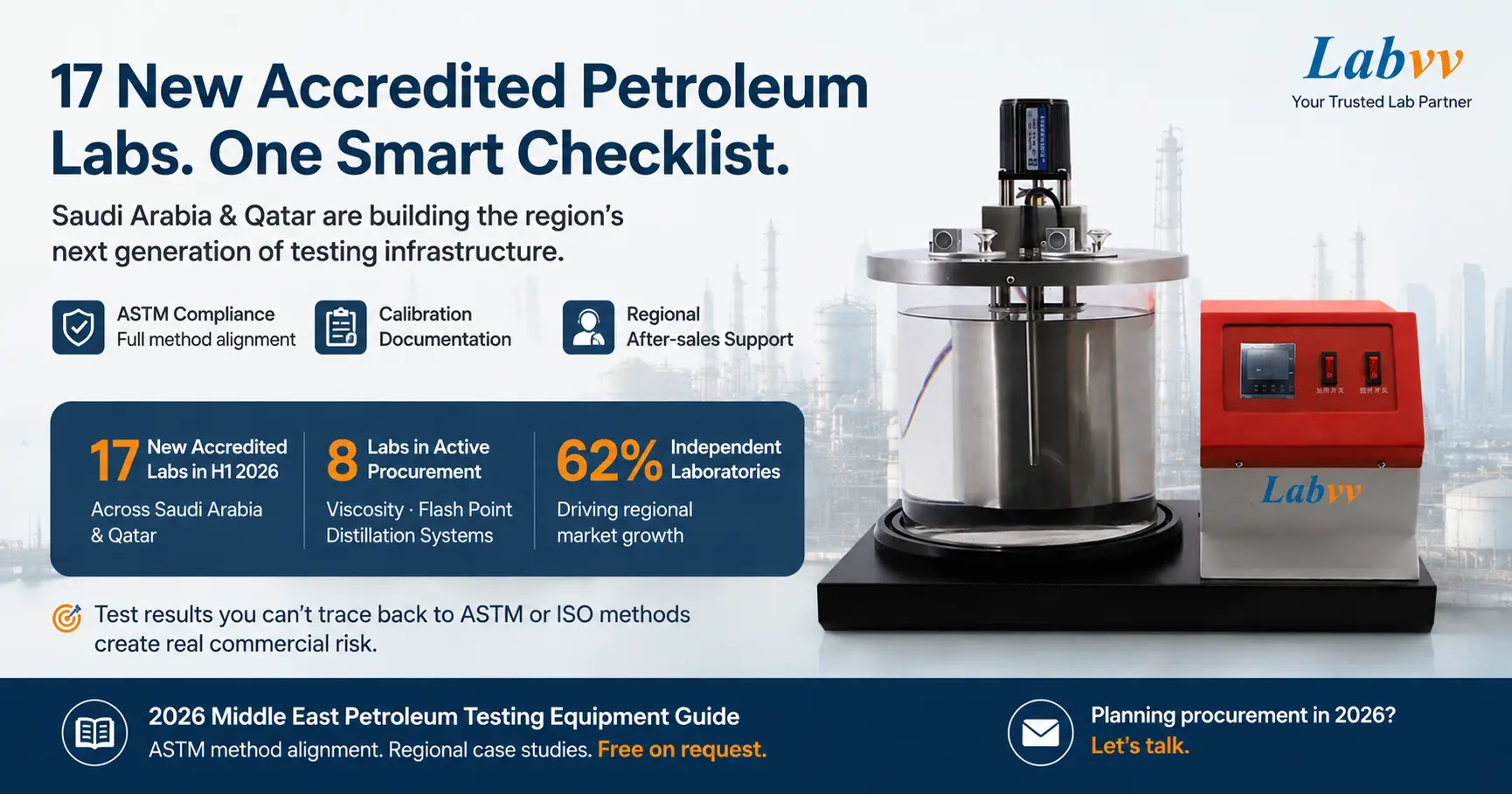
The demand for petroleum testing equipment in the Middle East is accelerating in 2026. Saudi Arabia’s Vision 2030 energy infrastructure investments and Qatar’s expanding LNG export program have triggered a wave of new laboratory openings across the GCC region. Our latest regional market scan identified 17 new accredited petroleum testing laboratories launched across Saudi Arabia and Qatar in the first half of 2026 alone — all prioritizing ASTM-compliant equipment to meet international trade and regulatory requirements.
For operators in the region, non-compliant testing equipment is more than an operational risk. It can result in rejected export cargoes, failed regulatory audits, and lost contracts with clients such as Saudi Aramco and QatarEnergy. This expansion signals a clear industry shift: GCC laboratories are not simply purchasing instruments — they are investing in compliance documentation, regional after-sales support, and calibration services aligned with international standards.
Key ASTM Standards for Petroleum Testing Equipment in the Middle East
- ✅ ASTM D445: Kinematic viscosity testing for crude oil and refined products
- ✅ ASTM D92: Open cup flash point testing for lubricants and high-flash fuels
- ✅ ASTM D287: API gravity measurement for crude oil classification
- ✅ ASTM D7279: Automated capillary viscosity testing for high-throughput laboratory operations
- ✅ ASTM D86: Distillation testing for fuel specification and quality control
What Is Driving Petroleum Testing Equipment Demand Across the GCC?
Two converging forces are reshaping the Middle East petroleum testing equipment market in 2026.
Saudi Arabia’s Vision 2030 program is accelerating domestic refinery capacity and downstream energy services, requiring a corresponding expansion of certified testing infrastructure. At the same time, Qatar’s North Field LNG expansion obligates producers and traders to present internationally traceable test results at every stage of the supply chain — from wellhead to export terminal.
Of the 17 new laboratories identified in our scan, 8 are already in the active procurement phase for three core instrument categories: kinematic viscosity testers, flash point analyzers, and petroleum distillation systems. Leading global TIC groups — including Cotecna, SGS, and Bureau Veritas — have also announced new or expanded GCC operations and are updating their testing fleets to meet increased regional demand from energy and construction projects.
Independent laboratories account for 62% of the new openings. Regional governments across the GCC have eased third-party testing registration requirements, creating entry opportunities for smaller operators serving the construction, manufacturing, and downstream energy sectors. For these labs, the procurement priority is straightforward: ASTM-compliant instruments with full certification documentation, at a price point sustainable for a new operation.
ASTM Compliance Requirements for Middle East Petroleum Laboratories
ASTM standards remain the internationally recognized benchmark for petroleum product testing across the GCC. Laboratories supplying results to Aramco, QatarEnergy, or global TIC clients must ensure all instruments produce results traceable to the relevant ASTM or ISO method.
Non-traceable results carry direct commercial consequences: cargo rejections at port, failed accreditation audits, and exclusion from approved supplier lists maintained by national oil companies. For any laboratory sourcing petroleum testing equipment for Middle East operations, ASTM method alignment is a non-negotiable procurement criterion — not an optional upgrade.
The most frequently required standards across new GCC laboratory openings in 2026 include viscosity (ASTM D445, D7279), flash point (ASTM D92), distillation (ASTM D86), and API gravity (ASTM D287). Laboratories handling lubricants and transformer oils also commonly require oxidation stability testing (ASTM D525 / D873) and acid number determination (ASTM D664).
Recommended LabVV Petroleum Testing Equipment for GCC Laboratories
- A1009 Automatic Kinematic Viscometer (ASTM D445) — High-throughput viscosity testing for crude oil and refined petroleum products
- A1020 Automatic Open Cup Flash Point Tester (ASTM D92) — Cleveland open cup flash point testing for lubricants and high-flash petroleum products
- A1014 Automated Capillary Viscometer (ASTM D7279) — Fast, repeatable viscosity measurement for high-volume laboratory operations
- A2000 Petroleum Distillation Tester (ASTM D86) — Fractional distillation analysis for fuel specification and quality control
Sourcing Petroleum Testing Equipment for the Middle East: Supplier Considerations
For laboratories in Saudi Arabia, UAE, Qatar, and Bahrain sourcing petroleum testing instruments in 2026, supplier selection typically comes down to four factors beyond instrument specifications: ASTM certification documentation, regional after-sales support availability, delivery lead times, and total cost of ownership relative to European or US-branded alternatives.
China-manufactured petroleum testing instruments have moved significantly upmarket over the past decade. Instruments from qualified suppliers now carry full third-party ASTM and ISO certification, ship with calibration certificates, and are supported by regional partner networks. For independent laboratories with tighter procurement budgets, this represents a genuine compliance-compliant alternative — not a compromise.
As a petroleum testing equipment supplier with over 10 years of experience serving Middle East markets, LabVV has supported 27 accredited laboratories across the GCC with instrument procurement and compliance consulting. Key supply capabilities for regional buyers include:
- ASTM/ISO certification included: All instruments ship with third-party calibration certificates traceable to relevant ASTM and ISO standards
- Flexible order quantities: Single-unit orders available for new laboratory startups; bulk pricing for multi-site laboratory networks
- Regional after-sales support: English and Arabic technical support, with local partner coverage across Saudi Arabia, UAE, Qatar, and Bahrain for on-site calibration and maintenance
- Delivery lead times: Standard models ship within 7 working days; custom configurations within 21 days
GCC Petroleum Testing Market Outlook Through 2030
The structural drivers behind the current laboratory expansion in Saudi Arabia and Qatar are not short-term. Refinery capacity additions under Vision 2030, ongoing North Field LNG development, and tightening regional fuel quality regulations will continue to increase demand for accredited petroleum testing services through the end of the decade.
For laboratories investing in petroleum testing equipment for the Middle East now, the priority is building instrument configurations that can handle both current accreditation requirements and the expanded testing scope that increased regional production will demand. Viscosity, flash point, distillation, and sulfur analysis remain the core capabilities — with growing interest in automated high-throughput systems as lab sample volumes increase.
Independent laboratories entering the market in 2026 are well-positioned to capture share as demand for third-party testing services grows across energy, construction, and manufacturing sectors. The labs that invest in verified ASTM-compliant equipment from the outset will carry a meaningful advantage in accreditation timelines and client acquisition.
📥 Free Download: Petroleum Laboratory Equipment Checklist
Planning a new petroleum testing laboratory or upgrading existing GCC lab capabilities?
✅ Recommended instrument configurations by lab type
✅ Laboratory setup and accreditation guidelines
✅ Calibration and maintenance requirements
Submit your email and we will send the checklist directly to your inbox.
Equipment Inquiry via WhatsApp
Contact us directly for instrument specifications, regional pricing, or delivery timelines for GCC orders.
Sources: Saudi Aramco Supplier Registration Portal, QatarEnergy North Field Expansion project updates, GCC Laboratory Accreditation Board (GAB) 2026 report, TIC Group regional expansion announcements, LabVV regional market scan (June 2026). All project references based on publicly available information as of June 2026.
Frequently Asked Questions
How long does it take to ship petroleum testing equipment to the Middle East?
Air freight to major GCC hubs (Dubai, Doha, Riyadh, Kuwait City) typically takes 5–8 working days. LabVV packs all instruments in export-grade wooden crates suitable for air transport. Sea freight is also available for larger orders with a lead time of 20–30 days.
Does LabVV provide after-sales support in the Middle East?
Yes. We offer remote technical support via video call, WhatsApp, and email. For larger projects, on-site installation and training can be arranged. We also work with local distributors in select GCC countries for faster service response.
Can LabVV instruments handle the ambient conditions in Middle East laboratories?
All LabVV instruments are designed for reliable operation in ambient temperatures up to 40°C. For laboratories in extreme desert environments, we recommend air-conditioned lab spaces for optimal instrument performance and measurement accuracy.