
Standard Reference: ASTM D445-24 — Standard Test Method for Kinematic Viscosity of Transparent and Opaque Liquids →
Introduction to ASTM D445
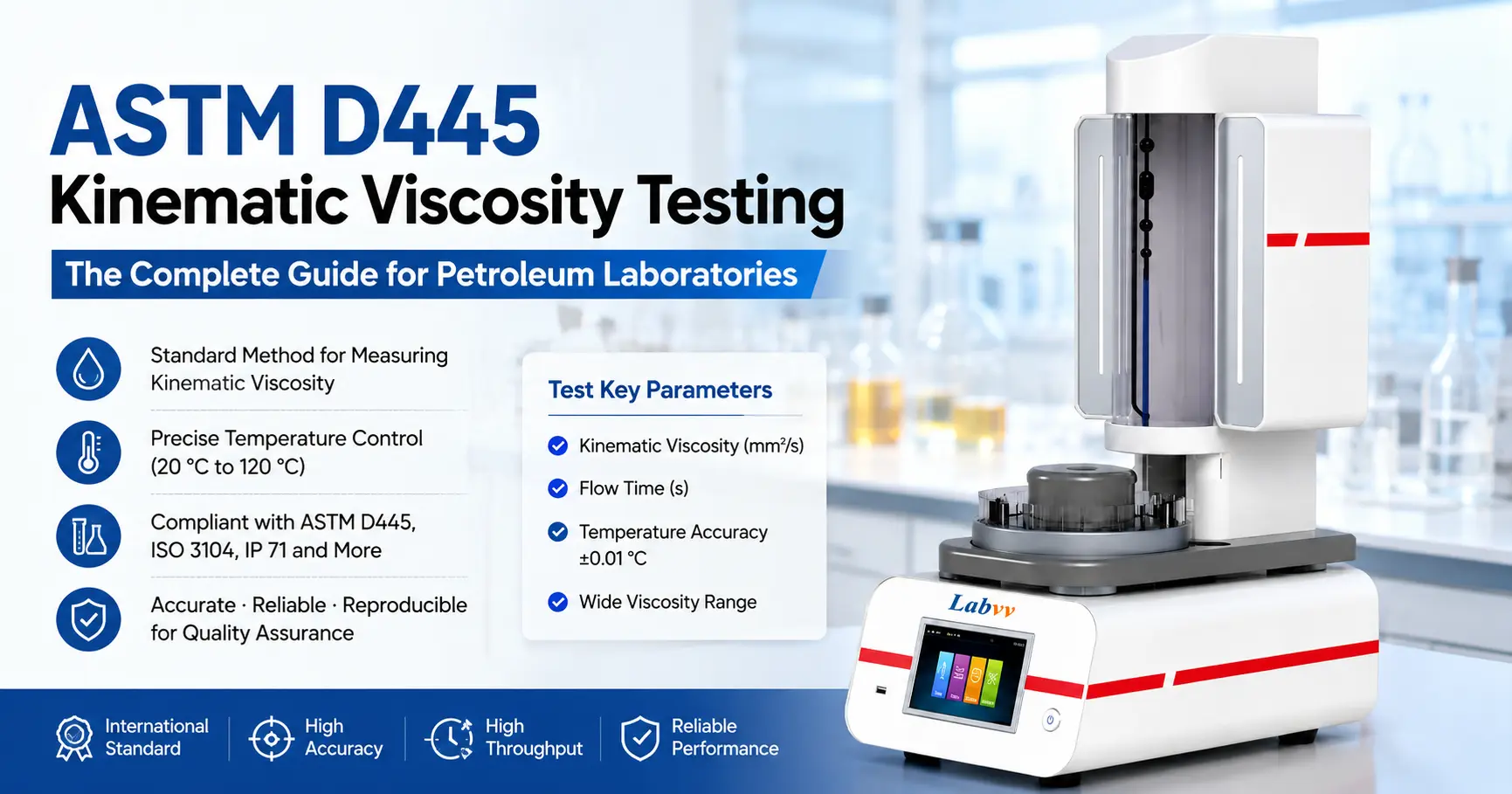
ASTM D445 is the internationally recognized standard test method for determining the kinematic viscosity of transparent and opaque liquids, including petroleum products, lubricating oils, and liquid fuels. Published by ASTM International, this standard defines the precise procedure for measuring the time it takes for a fixed volume of liquid to flow under gravity through a calibrated glass capillary viscometer at a strictly controlled temperature.
Kinematic viscosity is one of the most fundamental physical properties of petroleum products. It directly affects flow behavior, lubrication performance, and the operational reliability of oils and fuels. Compliance with ASTM D445 is essential for quality assurance across the petroleum supply chain, from crude oil refining to finished lubricant certification.
Standard: ASTM D445 — Standard Test Method for Kinematic Viscosity of Transparent and Opaque Liquids (and Calculation of Dynamic Viscosity)
Scope: Liquid petroleum products, transparent and opaque, at 20 °C to 120 °C
Key Parameters: Kinematic viscosity (mm²/s) · Flow time (s) · Temperature accuracy ±0.01 °C
Equivalent Standards: ISO 3104 · IP 71 · DIN 51562 · JIS K2283 · GB/T 265
Standard Reference: ASTM D445-24 — Standard Test Method for Kinematic Viscosity of Transparent and Opaque Liquids →
What Is Kinematic Viscosity?
Kinematic viscosity (ν) is defined as the ratio of dynamic viscosity (μ) to the density (ρ) of a fluid under the influence of gravity:
- ν — Kinematic viscosity, mm²/s (= cSt)
- μ — Dynamic viscosity, mPa·s
- ρ — Fluid density at test temperature, g/cm³
For petroleum products, kinematic viscosity is measured at standard reference temperatures — typically 40 °C for industrial lubricants and 100 °C for engine oils. The ASTM D445 method uses a calibrated glass capillary viscometer immersed in a precisely regulated temperature bath. The time required for the liquid to flow between two etched marks is multiplied by the viscometer’s calibration constant to calculate the final result.
Standard Reference: ASTM D445-24 — Standard Test Method for Kinematic Viscosity of Transparent and Opaque Liquids →
Why ASTM D445 Matters in the Petroleum Supply Chain
Kinematic viscosity is a critical quality parameter that determines how a fluid performs under specific thermal and mechanical stresses.
| Application Sector | Operational Importance of Kinematic Viscosity |
|---|---|
| Engine Oil Formulation | SAE viscosity grade classification (SAE J300) relies on kinematic viscosity at 100 °C to ensure proper engine protection. |
| Industrial Lubricants | ISO viscosity grades (ISO 3448) are determined by kinematic viscosity at 40 °C for gear and bearing lubrication. |
| Fuel Oil Quality | Viscosity directly affects atomization, combustion efficiency, and pumpability in diesel and marine engines. |
| Hydraulic Fluids | Proper viscosity ensures system efficiency, minimizes internal leakage, and provides component wear protection. |
| Used Oil Analysis (UOA) | Viscosity deviations indicate oil degradation, oxidation, thermal cracking, or contamination such as fuel dilution. |
| Crude Oil Logistics | Pipeline design, friction loss calculations, and pumping station power requirements depend on crude oil viscosity. |
Standard Reference: ASTM D445-24 — Standard Test Method for Kinematic Viscosity of Transparent and Opaque Liquids →
ASTM D445 Test Procedure Overview
Achieving accurate and repeatable viscosity measurements requires a strict sequence of steps as mandated by the standard:
- Viscometer Selection: Select a calibrated glass capillary viscometer with an internal diameter appropriate for the sample’s expected viscosity, ensuring a flow time between 200 and 800 seconds.
- Temperature Bath Preparation: Bring the constant-temperature bath to the required test temperature (typically 40 °C or 100 °C) with a regulatory precision of ±0.01 °C.
- Sample Loading & Thermal Equilibration: Charge the sample into the viscometer without introducing air bubbles. Allow equilibration in the bath for 15–30 minutes.
- Flow Time Measurement: Draw the fluid meniscus above the upper timing mark using suction or gravity, then measure the exact time in seconds for the meniscus to travel to the lower mark.
- Calculation & Reporting: Multiply the measured flow time by the viscometer calibration constant to obtain kinematic viscosity in mm²/s. Report to three significant figures at the specified test temperature.
Precision & Bias (per ASTM D445): Repeatability (r) = 0.35 % of the mean · Reproducibility (R) = 0.70 % of the mean at 40 °C and 100 °C for petroleum distillates. These precision limits are the benchmark against which automated instrument performance is evaluated.
Standard Reference: ASTM D445-24 — Standard Test Method for Kinematic Viscosity of Transparent and Opaque Liquids →
ASTM D445 vs. Alternative Viscosity Test Methods
Modern laboratories often balance the strict requirements of reference methods with the throughput needs of high-volume testing. The table below compares the most widely used standard methods:
| Standard | Instrument Type | Sample Volume | Test Time | Primary Use Case |
|---|---|---|---|---|
| ASTM D445 | Traditional Glass Capillary Viscometer (e.g., LabVV A1009) | ~10–15 mL | 15–30 min | Gold standard reference; universally accepted for transparent and opaque liquids |
| ASTM D7279 | Automated Folded Capillary Viscometer (e.g., LabVV A1014) | 0.3–1.0 mL | 3–5 min | High-throughput QC and commercial labs; rapid testing with minimal sample waste |
| ASTM D7042 | Stabinger Rotational Viscometer | ~3 mL | 5–10 min | Dynamic and kinematic viscosity for dark oils over wide temperature ranges |
| ASTM D7483 | Oscillating Piston Viscometer | ~2 mL | 2–5 min | Process control, in-line monitoring, and field testing |
Standard Reference: ASTM D445-24 — Standard Test Method for Kinematic Viscosity of Transparent and Opaque Liquids →
LabVV Automated Solutions for Kinematic Viscosity Testing
To eliminate manual timing errors and improve laboratory throughput, LabVV offers two automated viscometers engineered in full compliance with global petroleum testing standards.
LabVV A1009 — Automatic Kinematic Viscometer
(ASTM D445 · ISO 3104 Reference Compliance)
Engineered for laboratories that require strict adherence to traditional glass capillary reference workflows while upgrading to automated efficiency.
- Fully automated measurement, calculation, and cleaning cycle — zero operator intervention
- Metrology-grade PID temperature regulation with PT100 sensor
- 12-inch HD industrial touchscreen with real-time flow curves
- Adjustable wash cycles, solvent soak times, and high-velocity air drying
- USB data export and PC software connectivity
LabVV A1014 — High-Throughput Automatic Capillary Viscometer
(ASTM D7279)
Designed for busy oil analysis laboratories, commercial testing facilities, and blending plants requiring maximum speed and minimum sample consumption.
- 3-minute cycle time per sample — fastest in class
- 0.3–1.0 mL sample volume per test
- Dual-bath architecture: run 4 samples simultaneously at two temperatures (e.g., 40 °C and 100 °C)
- High-sensitivity infrared photoelectric meniscus detection
- Integrated low-noise −70 kPa vacuum pump for smooth sample handling
- Measurement range: 3–3000 mm²/s · Temperature range: 20–120 °C
Product Selection Guide
🔵 For Reference & Compliance Labs — If your facility requires direct, uncompromised compliance with traditional glass capillary testing for international trade or third-party certification, the LabVV A1009 is the right choice.
🟡 For High-Volume QC & Predictive Maintenance — If your goals are high sample throughput, rapid turnaround, and lower operating costs per test, the LabVV A1014 delivers unmatched speed and efficiency.
Standard Reference: ASTM D445-24 — Standard Test Method for Kinematic Viscosity of Transparent and Opaque Liquids →
Frequently Asked Questions — ASTM D445 Kinematic Viscosity Testing
What is the difference between ASTM D445 and ISO 3104?
ASTM D445 and ISO 3104 are technically equivalent and produce the same results. Both use a calibrated glass capillary viscometer in a controlled temperature bath. The primary difference is the issuing body: ASTM D445 is published by ASTM International and is predominant in North America and the Middle East, while ISO 3104 is published by the International Organization for Standardization and is more commonly specified in European and international trade contracts. Most modern automated viscometers, including the LabVV A1009, comply with both standards simultaneously.
What is the difference between ASTM D445 and ASTM D7279?
ASTM D445 is the primary reference method using traditional glass capillary viscometers with 10–15 mL samples and a 15–30 minute test time. ASTM D7279 uses an automated folded (modified Ubbelohde-type) capillary viscometer requiring only 0.3–1.0 mL of sample and delivering results in approximately 3–5 minutes. ASTM D7279 results are correlatable to ASTM D445 and are widely accepted for routine quality control, though some trade specifications and certification contracts still mandate the D445 reference method. If you need both compliance and speed, the LabVV A1014 (ASTM D7279) paired with the LabVV A1009 (ASTM D445) covers both requirements.
Which viscometer do I need for testing opaque or dark petroleum oils?
Both ASTM D445 and ASTM D7279 cover opaque liquids. For dark or opaque oils such as used engine oils, residual fuel oils, or heavy base oils, an automated viscometer with an infrared photoelectric meniscus detection system — such as the LabVV A1014 — is strongly recommended. Infrared detection eliminates the subjectivity of visual meniscus timing that manual glass capillary methods require for opaque samples, and is the standard approach specified in ASTM D446 (the companion specification to D445 for opaque liquids).
At what temperatures is ASTM D445 kinematic viscosity typically measured?
The two most common test temperatures are 40 °C (104 °F) and 100 °C (212 °F). Industrial lubricants and hydraulic fluids are typically graded by their kinematic viscosity at 40 °C in accordance with ISO 3448. Engine oils (per SAE J300) are graded by their kinematic viscosity at 100 °C. Fuel oils, transformer oils, and specialty fluids may be tested at other temperatures such as 20 °C, 50 °C, or 80 °C depending on the applicable specification. ASTM D445 supports testing across the full range of 20 °C to 120 °C.
What are the repeatability and reproducibility limits for ASTM D445?
Per ASTM D445, the repeatability limit (r) — the maximum acceptable difference between two test results obtained by the same operator on the same instrument — is 0.35% of the mean value. The reproducibility limit (R) — the maximum acceptable difference between two results obtained by different laboratories — is 0.70% of the mean. These precision limits apply for petroleum distillates at 40 °C and 100 °C. Automated viscometers generally achieve repeatability well within these limits by eliminating manual timing error and operator variability.
How often should a kinematic viscometer be calibrated?
ASTM D445 does not prescribe a specific calibration interval, but the standard requires that viscometers be calibrated using certified reference standards traceable to national metrology institutes (such as NIST). Most accredited petroleum testing laboratories calibrate their viscometers annually or whenever the instrument is serviced, relocated, or shows a deviation from reference standards. For high-volume commercial laboratories, quarterly verification against certified viscosity reference standards (CRMs) is common practice. The temperature bath should also be verified regularly against calibrated thermometers.
Can ASTM D445 be used to test jet fuel and diesel fuel viscosity?
Yes. ASTM D445 is routinely used for jet fuel and diesel fuel viscosity testing. Jet fuel viscosity is typically measured at −20 °C per ASTM D1655 (aviation turbine fuels), which references ASTM D445 as the test method. Diesel fuel viscosity is typically measured at 40 °C per ASTM D975 and EN 590 specifications. For low-viscosity fuels, selecting a viscometer tube with a sufficiently narrow capillary bore to achieve flow times within the 200–800 second window is critical for accuracy.
Need a Reliable ASTM D445 or ASTM D7279 Viscometer?
Contact LabVV’s engineering team for expert application advice, instrument selection guidance, and competitive pricing. We serve petroleum laboratories across the Middle East, Southeast Asia, and worldwide.
Standard Reference: ASTM D445-24 — Standard Test Method for Kinematic Viscosity of Transparent and Opaque Liquids →
Conclusion
ASTM D445 remains the gold standard for kinematic viscosity measurement of petroleum products worldwide. From lubricant formulation to fuel quality control, accurate viscosity data ensures product performance, regulatory compliance, and operational reliability. Modern automated viscometers — such as the LabVV A1009 and the LabVV A1014 — significantly reduce operator effort while improving precision and throughput compared to traditional manual glass capillary methods.
For more information about kinematic viscosity testing standards and LabVV’s complete range of petroleum testing instruments, contact our team today.
Last updated: June 2026 | Published by LabVV Technical Team