
Flash point is the lowest temperature at which a material’s vapors ignite. It’s a critical safety parameter for fire risk assessment, fuel quality control, transport classification under UN / IMO / DOT regulations, and product specification.
For commercial testing laboratories, choosing between ASTM D93 (Pensky-Martens Closed Cup) and ASTM D92 (Cleveland Open Cup) directly affects the scope of services you can offer and your lab’s compliance with international standards.
This guide compares both methods, explains which one applies to which product, and recommends the right flash point testing equipment for your lab.
ASTM D93 vs D92: Core Differences
ASTM D93 — Pensky-Martens Closed Cup (PMCC)
The sample is heated in a sealed closed cup. A test flame is introduced through a small opening at regular intervals. Because vapors are trapped inside the cup, this method is more sensitive to low flash point detection and is preferred for regulatory compliance testing.
- Temperature range: 40°C to 360°C
- Repeatability: ±2°C
- Best for: Fuels, solvents, diesel, gasoline, low-to-mid flash point products
- Standards: ASTM D93, IP 34, ISO 2719
ASTM D92 — Cleveland Open Cup (COC)
The sample is heated in an open cup without a lid. Because vapors escape freely, this method produces higher flash point values than closed cup methods for the same material. It’s the standard method for lubricating oils and heavy petroleum products.
- Temperature range: 79°C to 400°C
- Repeatability: ±5.5°C
- Best for: Lubricating oils, transformer oils, heavy fuel oil, bitumen
- Standards: ASTM D92, IP 36, ISO 2592
📖 Learn more: ASTM D93 Flash Point Test Method (Pensky-Martens) | ASTM D92 Cleveland Open Cup Method
Which Standard Applies to Which Product?
Use ASTM D93 (Closed Cup) for:
- Diesel fuel, biodiesel, kerosene, gasoline
- Volatile solvents and light petroleum distillates
- Aviation turbine fuel
- Any material with a flash point below 79°C
Use ASTM D92 (Open Cup) for:
- Engine oils and lubricating oils
- Heavy fuel oil (HFO / bunker fuel)
- Transformer oil
- Bitumen and asphalt
- Any material with a flash point above 79°C
💡 Rule of Thumb
If the product could be flammable at room temperature (below 60°C), always use a closed cup method (ASTM D93). Open cup methods (ASTM D92) are for higher flash point materials where vapor accumulation is not a concern.
Flash Point Comparison: D93 vs D92 on Common Products
| Product | D93 (Closed Cup) | D92 (Open Cup) |
| Diesel | 52–96°C | 70–120°C |
| Light Lubricating Oil | 160–200°C | 180–220°C |
| Transformer Oil | 135–175°C | 150–195°C |
| Heavy Lubricating Oil | 200–250°C | 220–270°C |
| Bitumen / Asphalt | >250°C | 260–350°C |
Closed cup consistently yields 15–25°C lower flash points because vapors are contained. This is not an error — it’s a fundamental methodological difference. When specifying a flash point, always reference the test method used.
Regulatory Requirements: Which Standard Do Certifying Bodies Require?
| Regulation / Standard | Required Method |
| UN ADR / IATA / IMDG (Flammable Liquid Classification) | D93 (closed cup) |
| OSHA / NFPA 30 (Flammable vs. Combustible) | D93 |
| EPA Hazardous Waste Characterization | D93 |
| ASTM D975 (Diesel Fuel Specification) | D93 |
| ASTM D396 (Fuel Oil Specification) | D93 |
| API / ISO 6743 (Lubricant Classification) | D92 |
| ASTM D3487 (Transformer Oil) | D92 |
| IMO MARPOL (Marine Fuel Oil) | D92 |
If your lab handles regulatory compliance testing (UN classification, EPA, OSHA), you must have ASTM D93 capability. If you primarily test lubricants and heavy petroleum products, ASTM D92 is sufficient.
LabVV Flash Point Tester Recommendations
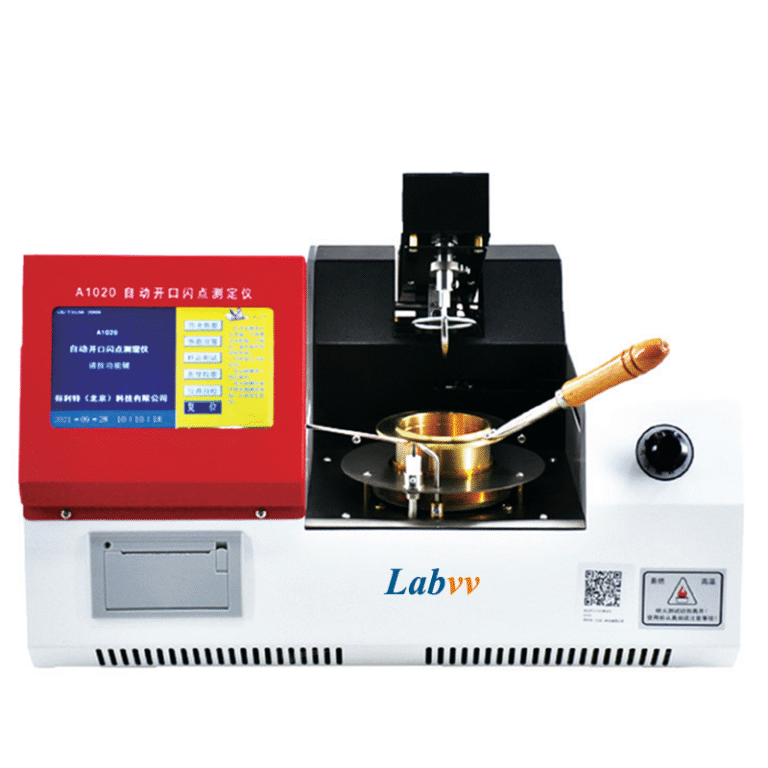
LabVV A1020 — Automatic Open Cup Flash Point Tester (ASTM D92)
Best for testing lubricating oils, transformer oils, heavy fuel oil, and bitumen. Features automatic flame detection, programmable heating, and digital interface.
For ASTM D93 closed cup testing, refer to our complete ASTM D93 test method guide covering Pensky-Martens apparatus specifications and operating procedures.
Complementary Products for a Complete Oil Testing Lab
A flash point tester is just one component of a well-equipped petroleum laboratory. Consider these related instruments:
- A1009 Automatic Kinematic Viscometer — ASTM D445 viscosity testing
- A2000 Automatic Distillation Tester — ASTM D86 distillation
- A2140 XRF Sulfur Analyzer — ASTM D4294 sulfur content
Which Flash Point Tester Should You Buy?
Scenario 1: Commercial Testing Lab
Buy an open cup tester (A1020 for D92) + a closed cup apparatus (D93). This combination covers 95%+ of flash point testing requests, from fuels to lubricants.
Scenario 2: Petroleum Refinery Lab
Start with D93 closed cup for diesel, gasoline, and process streams. Add D92 open cup for lube oil and asphalt testing as needed.
Scenario 3: Lubricant / Grease Manufacturer
Start with D92 open cup (A1020). Most lubricant specifications reference D92. Add D93 only if you test incoming solvents.
Scenario 4: Environmental / Compliance Lab
Focus on D93 closed cup. EPA, OSHA, and UN classification all require closed cup data.
5 Common Flash Point Testing Mistakes
⚠️ 5 Common Flash Point Testing Mistakes
Avoid these errors to ensure accurate, compliant results.
❌ Using D92 when D93 is required
Diesel fuel specification ASTM D975 requires D93. Open cup results are not valid for certification.
❌ Ignoring the method in specifications
“Flash point > 180°C” is meaningless without the method. 180°C by D93 is roughly 200°C by D92. Always state the method.
❌ Skipping daily calibration
A 15-minute daily check with certified reference oil prevents invalid results for an entire batch.
❌ Wrong sample volume
Overfilling or underfilling changes the vapor space and affects results. Use the graduated fill line.
❌ Testing without proper cooling
Running a second test while the instrument is still hot produces falsely low flash points. Wait for the cup to cool to within 10°C of ambient.
Conclusion
Choosing between ASTM D93 and D92 depends on the materials you test and regulatory requirements. For most commercial testing labs, having both methods available is the correct answer — it enables your lab to accept flash point testing for virtually any petroleum product.
👉 Browse our complete oil analysis equipment guide →
👉 View LabVV A1020 Automatic Open Cup Flash Point Tester →
Need help selecting the right flash point tester? Contact us for a free recommendation based on your testing requirements.