
Product Overview
Used oil analysis is the foundation of predictive maintenance in the petroleum, power generation, marine, and heavy equipment industries. Testing in-service lubricants and hydraulic oils reveals wear metal contamination, fluid degradation, cross-contamination, and additive depletion — providing early warning of component failure before costly breakdowns occur.
For commercial testing laboratories, choosing the right used oil analysis equipment directly impacts testing accuracy, turnaround time, and customer confidence. This guide covers the essential parameters, available instrument types, and a practical selection framework.
The Core Parameters: What You Need to Test
A complete used oil analysis program typically evaluates 6–12 parameters depending on the oil type and equipment being monitored.
1. Viscosity — ASTM D445 / D7279
Viscosity is the single most important property of a lubricant. Changes of more than ±10% from the fresh oil value indicate a problem.
- Viscosity increase → oxidation, soot buildup, additive degradation
- Viscosity decrease → fuel dilution, incorrect oil grade, thermal shearing
Recommended: LabVV A1014 Automatic Capillary Viscometer (ASTM D7279) for high-throughput labs, or A1009 Automatic Kinematic Viscometer (ASTM D445) for referee testing.
2. Total Acid Number (TAN) — ASTM D664
TAN measures oil oxidation by titrating acidic compounds formed during service. Rising TAN signals the need for an oil change. Rapid TAN increase points to thermal stress or extended drain intervals.
LabVV offers precision titration instruments for TAN/TBN analysis — contact us for model recommendations based on your testing volume.
3. Total Base Number (TBN) — ASTM D2896 / D4739
For engine oils, TBN measures the alkaline reserve available to neutralize acidic combustion byproducts. TBN depletion indicates an imminent oil change is needed.
4. Water Content — ASTM D6304 / D95
Water contamination accelerates wear, promotes corrosion, and reduces film strength. Methods include Karl Fischer titration (D6304) for precise ppm-level measurement and distillation (D95) for higher water content ranges.
5. Flash Point — ASTM D93 / D92
Flash point testing detects fuel dilution in engine oils and volatile contamination in industrial lubricants. Lowered flash point → fuel dilution (critical for diesel engines).
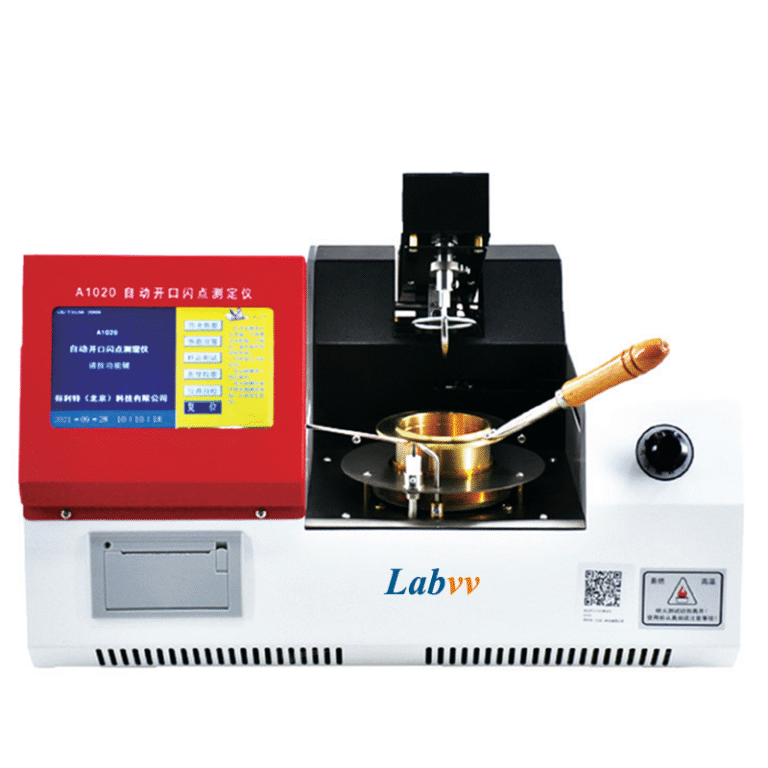
Recommended: A1190 Closed Cup Flash Point Tester (ASTM D93) for regulatory compliance or A1020 Open Cup Flash Point Tester (ASTM D92) for lubricating oils.
6. Particle Count and Wear Metals
Elemental analysis identifies specific wear metals (Fe, Cu, Pb, Al, Cr, Sn) and their concentrations, helping pinpoint which component is wearing.
Recommended: A1031S Automatic Oil Particle Counter or A1035 Portable Particle Counter for field use.
7. Oxidation and Nitration — FTIR (ASTM E2412)
FTIR spectroscopy provides rapid screening for oxidation, nitration, sulfation, and additive depletion in a single scan.
Types of Used Oil Analysis Equipment
Portable Test Kits
Best for: Field screening, quick go/no-go decisions, small fleets
- Low cost, no lab required, instant results
- Limited parameters, lower precision, not ASTM-compliant
LabVV recommendation: For preliminary field screening only. Not suitable for commercial lab certification.
Benchtop Analyzers
Best for: In-house maintenance labs, mid-size testing facilities
- Multi-parameter capability, ASTM-compliant methods
- Moderate throughput (20–50 samples/day)
LabVV recommendation: The standard choice for most industrial lubricant analysis programs. A combination of A1014 Automatic Viscometer + titration analyzer covers the majority of routine used oil testing volume.
Full Laboratory Systems
Best for: Commercial testing labs, large corporations
- Highest accuracy, full parameter coverage
- High throughput (100+ samples/day)
LabVV recommendation: Combine automatic viscometer + flash point tester + water content analyzer + A2140 XRF Sulfur Analyzer for comprehensive coverage.
On-Line / In-Line Sensors
Best for: Continuous monitoring of critical assets (turbines, compressors, large gearboxes)
- Real-time data, trend monitoring
- Supplementary lab testing still needed for detailed diagnostics
How to Choose: A Practical 5-Step Framework
Step 1: Define Your Testing Volume
| Volume | Equipment Class |
| < 20 samples/week | Portable + basic benchtop |
| 20–100 samples/week | Full benchtop suite (viscometer + flash point + titration) |
| > 100 samples/week | Automated lab system with array viscometers |
Step 2: Identify Your Core Parameters
- Engine oil testing: Viscosity + TAN/TBN + Flash Point + Water → 4 instrument types minimum
- Hydraulic oil testing: Viscosity + Particle Count + Water → 3 instrument types
- Turbine oil testing: Viscosity + TAN + Water + RPVOT → 5 instrument types
Step 3: Check ASTM Compliance
📋 ASTM Compliance Checklist
If your lab offers certification testing, verify each instrument against its relevant ASTM standard. Non-compliant instruments limit your market to screening-only services.
• ✅ Viscometer: ASTM D445 or D7279 with certified calibration oils
• ✅ Flash Point: ASTM D93 (Pensky-Martens) or D92 (Cleveland)
• ✅ TAN/TBN: ASTM D664 / D2896 with non-aqueous electrode
• ✅ Water: ASTM D6304 (Karl Fischer coulometric)
Step 4: Evaluate Total Cost of Ownership
Beyond the purchase price, consider consumables (titration reagents, calibration standards), annual calibration costs, operator training, and warranty support. LabVV offers 12-month warranty and lifetime technical support.
Step 5: Consider Scalability
Can the viscometer handle multiple sample tubes? Does the titrator accept an autosampler? Is the software LIMS-compatible? Choose instruments that grow with your lab.
Recommended LabVV Configuration
| Parameter | Model | ASTM Standard |
| Kinematic Viscosity | A1009 / A1010 | ASTM D445 |
| Auto Viscosity (High Throughput) | A1014 | ASTM D7279 |
| Flash Point (Closed Cup) | A1190 | ASTM D93 |
| Flash Point (Open Cup) | A1020 | ASTM D92 |
| Particle Count | A1031S / A1035 | ISO 4406 |
| Sulfur Content | A2140 | ASTM D4294 |
| Oxidation Stability | A1100 | ASTM D2272 |
| Pour & Cloud Point | A1121 | ASTM D97 / D2500 |
Common Mistakes When Buying Used Oil Analysis Equipment
⚠️ 4 Common Mistakes When Buying Used Oil Analysis Equipment
Avoid these pitfalls that cost labs time, money, and credibility.
❌ Buying instruments without a parameter strategy. Map your target clients → identify most requested parameters → prioritize by revenue potential. A viscometer alone won’t generate revenue if your clients need full condition monitoring reports.
❌ Choosing manual to save money. Automatic instruments typically halve the per-test cost despite higher upfront investment. Calculate total cost per test (labor + consumables + depreciation), not just the purchase price.
❌ Ignoring calibration cost. Some budget instruments use non-standard calibration fluids that cost 3–5× more. Verify calibration cost and reference oil availability before purchase.
❌ Overlooking data management. If your instrument doesn’t export to LIMS or generate test reports automatically, every result needs manual transcription — a major source of errors and lost time. Choose instruments with PC connectivity, LIMS export, and automated report generation.
Conclusion
For most commercial lubricant testing labs, the optimal starting configuration includes an automatic kinematic viscometer for the highest-volume test, a flash point tester for safety and fuel dilution detection, and a titration analyzer for TAN/TBN. This three-instrument suite covers approximately 80% of routine used oil analysis requests.
👉 View LabVV A1014 Automatic Viscometer →
👉 View LabVV A1190 Closed Cup Flash Point Tester →
👉 Browse our complete oil analysis equipment guide →
Need help configuring your used oil analysis lab? Contact us for a free equipment recommendation based on your target parameters and expected sample volume.