
Middle East Refinery Expansion Projects and Petroleum Laboratory Equipment Demand in 2026
Market analysis based on publicly available project announcements from national oil companies, EPC contractor disclosures, and government industrial development programs across the GCC region. Updated June 2026.
The Middle East petroleum refining sector is entering a significant expansion phase in 2026, with multiple refinery projects, laboratory upgrades, and quality control programs underway across Saudi Arabia, the UAE, Qatar, Kuwait, and Oman. For petroleum testing laboratories and their equipment suppliers, understanding these developments is essential for strategic procurement planning.
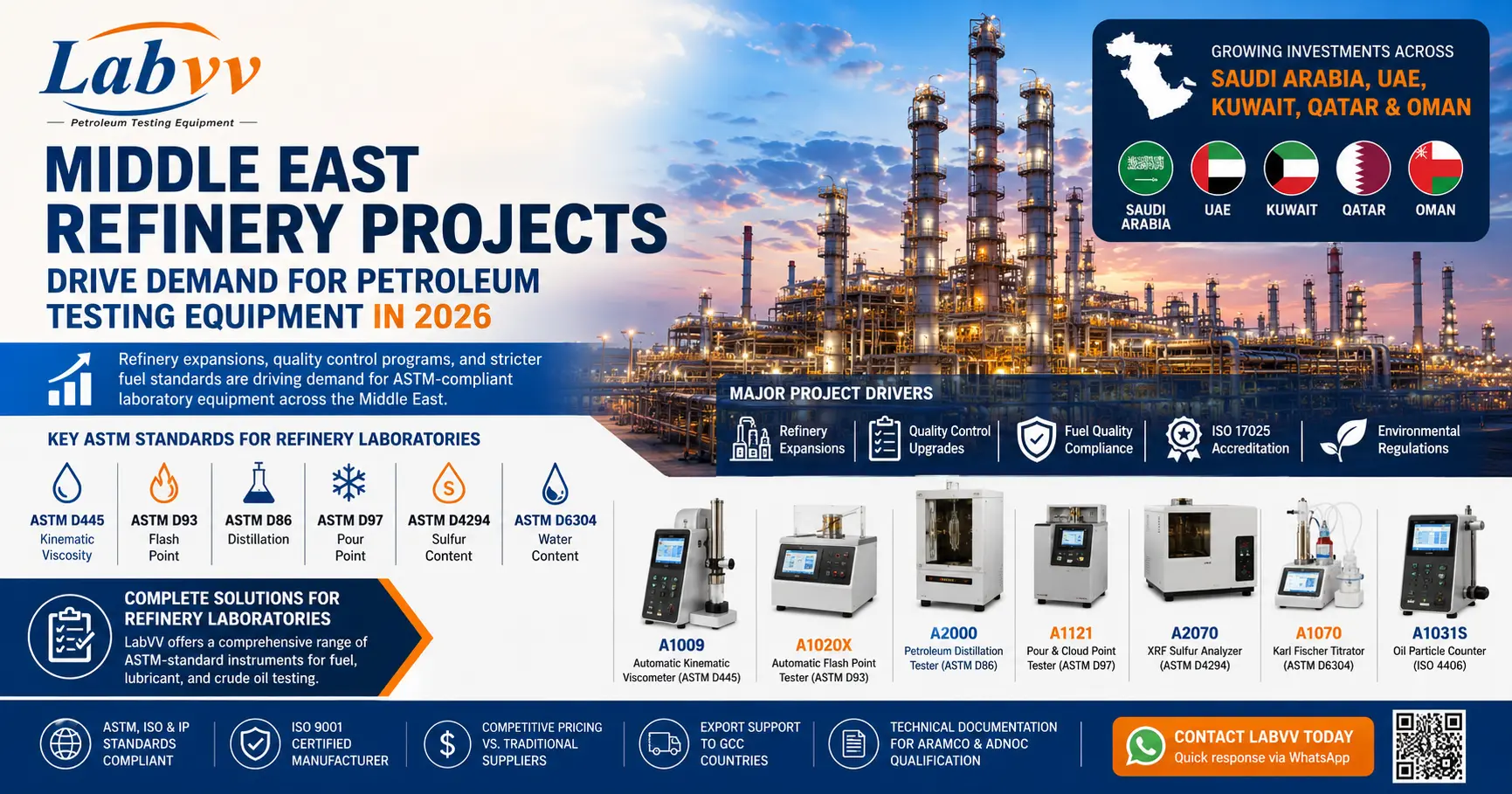
ASTM D445 — Kinematic Viscosity ·
ASTM D93 — Flash Point ·
ASTM D86 — Distillation ·
ASTM D97 — Pour Point ·
ASTM D4294 — Sulfur Content ·
ASTM D6304 — Water Content
Saudi Arabia: Vision 2030 Drives Refinery Laboratory Procurement
Saudi Arabia remains the largest market for petroleum testing equipment in the Middle East. According to Saudi Aramco’s publicly announced procurement programs and the Kingdom’s Vision 2030 industrial development plans, refinery expansion and laboratory modernization are key pillars of the downstream sector strategy.
SATORP Jubail Refinery
The SATORP refinery, a joint venture between Saudi Aramco (62.5%) and TotalEnergies (37.5%) in Jubail Industrial City, is one of the world’s most complex refining and petrochemical integration sites with a processing capacity of 460,000 barrels per day. Based on publicly available project documentation from Aramco and TotalEnergies, ongoing maintenance and laboratory quality assurance programs require continuous procurement of ASTM-standard testing equipment for fuel, lubricant, and petrochemical product analysis.
Petro Rabigh Refinery
The Petro Rabigh complex, a joint venture between Saudi Aramco and Sumitomo Chemical, continues to expand its petrochemical integration under Phase II development. The refinery’s laboratory operations require ongoing equipment procurement to maintain compliance with international ASTM standards and Saudi product quality regulations.
Ras Tanura Refinery
As one of the world’s largest refineries by crude oil processing capacity (approximately 550,000 bpd), Ras Tanura’s laboratory operations demand high-throughput, reliable testing equipment. Aramco’s in-house quality control network, disclosed through its supplier registration portal, maintains rigorous ASTM compliance requirements for all laboratory instrumentation.
Saudi Aramco Laboratory Testing Requirements
Aramco’s supplier qualification program, publicly documented through their procurement portal, requires all laboratory equipment to comply with ASTM International standards. The primary testing parameters include:
| Test Type | ASTM Standard | Application |
|---|---|---|
| Viscosity | ASTM D445 / D7279 | Lubricants, fuel oils, crude oil |
| Flash Point | ASTM D93 / D92 | Safety compliance, fuel classification |
| Distillation | ASTM D86 | Fuel quality, refinery process control |
| Pour Point | ASTM D97 | Cold-flow properties, winter fuel |
| Sulfur Content | ASTM D4294 | Environmental compliance, fuel quality |
| Water Content | ASTM D6304 | Contamination monitoring, fuel purity |
UAE: ADNOC’s Refining and Laboratory Network Expansion
Abu Dhabi National Oil Company (ADNOC) continues to expand its testing and laboratory capabilities across its value chain, as outlined in the ADNOC 2030 Strategy published through its official channels. The Ruwais refining and petrochemical complex, one of the world’s largest integrated sites, regularly procures laboratory equipment for quality assurance and product certification.
According to ADNOC’s publicly available procurement guidelines and vendor registration requirements, key laboratory equipment categories sought include automated viscometers, oxidation stability testers, distillation apparatus, and particle counters for contamination monitoring in fuels and lubricants.
Kuwait: Clean Fuels Project Laboratory Demand
Kuwait Petroleum Corporation’s (KPC) Clean Fuels Project at the Mina Al-Ahmadi and Mina Abdullah refineries represents one of the region’s largest refinery modernization programs. Based on KPC’s project disclosures and tender publications, the upgraded refineries require ASTM-standard testing instrumentation to certify product quality under the new specifications.
Qatar and Oman: Emerging Markets
QatarEnergy — Qatar’s expanded LNG production capacity, supported by the North Field Expansion project, has increased demand for hydrocarbon testing laboratories. Condensate and natural gas liquid (NGL) analysis requires specialized distillation and testing equipment.
Oman — Duqm Refinery — The Duqm Refinery project, a joint venture between Oman Oil Company (OQ) and Kuwait Petroleum International (KPI), represents one of the largest industrial investments in the Sultanate. With a processing capacity of 230,000 bpd, the refinery’s laboratory operations require ongoing procurement of petroleum testing equipment for product quality compliance and export certification.
The Role of EPC Contractors in Laboratory Equipment Procurement
For new refinery projects and expansions, laboratory equipment procurement is typically coordinated through international EPC (Engineering, Procurement, and Construction) contractors during the detailed engineering and commissioning phases. This makes EPC firms critical channels for laboratory equipment suppliers bidding on new projects. Major EPC firms active in Middle East refinery projects include:
- Technip Energies — Active in multiple refinery and petrochemical projects across the GCC, including ADNOC and Aramco-related contracts
- Petrofac — Engineering and procurement services for oil and gas facilities, with laboratory equipment specification expertise
- Worley — Provides project management and procurement coordination for laboratory infrastructure in refinery expansions
- Wood — Consulting and procurement services for laboratory design and equipment specification
- Samsung E&A — EPC contractor for major refinery and petrochemical projects across the Middle East
- Technicalas Reunidas — EPC firm with extensive refinery project experience in Saudi Arabia and the UAE
Laboratory equipment is typically specified by EPC contractors based on ASTM standards, making compliance with international testing methods essential for equipment suppliers seeking to participate in tender processes.
Recommended LabVV Equipment for Refinery Laboratories
LabVV Scientific offers a comprehensive range of petroleum testing instruments certified to ASTM standards, suitable for refinery laboratories across the Middle East:
Recommended Products for Refinery Laboratories
- LabVV A1009 Automatic Kinematic Viscometer — ASTM D445, high-throughput viscosity testing for lubricants and fuels
- LabVV A1020X Automatic Flash Point Tester — ASTM D93, closed and open cup flash point determination
- LabVV A2000 Petroleum Distillation Tester — ASTM D86, automated distillation analysis
- LabVV A1121 Pour and Cloud Point Tester — ASTM D97, D2500, low-temperature properties
- LabVV A2070 Sulfur Analyzer — ASTM D4294, XRF sulfur content analysis
- LabVV A1070 Karl Fischer Titrator — ASTM D6304, precision water content measurement
- LabVV A1031S Oil Particle Counter — Contamination monitoring for fuels and lubricants
Free Download: Petroleum Laboratory Equipment Checklist
Planning a new refinery laboratory or upgrading existing testing capabilities? Download our comprehensive checklist covering:
+ Recommended instrument configurations by application
+ Laboratory setup guidelines for refinery QC labs
+ Calibration and maintenance requirements
Enter your email and we will send the checklist directly to your inbox.
Quick Equipment Inquiry via WhatsApp
For immediate assistance with equipment specifications, pricing, or delivery timelines, message us directly.
Market Outlook: 2026-2027
Based on publicly announced project timelines and national oil company strategy documents, the Middle East petroleum testing equipment market is expected to continue growing through 2026-2027, driven by:
- Saudi Vision 2030 — Industrial diversification programs mandating enhanced quality control and testing infrastructure across the downstream sector
- ADNOC 2030 Strategy — Capacity expansion of refining and petrochemical operations requiring laboratory modernization
- IMO Fuel Regulation Compliance — Ongoing requirements for sulfur content testing (ASTM D4294), viscosity testing (ASTM D445), and distillation analysis (ASTM D86) to meet international marine fuel standards
- Lubricant Market Growth — Expanding automotive and industrial sectors driving demand for oil condition monitoring and lubricant testing equipment
Laboratory managers, procurement teams, and EPC contract engineers at refineries, third-party testing laboratories, and petrochemical plants should account for equipment upgrades and replacements to maintain ASTM compliance and ensure product quality for both domestic consumption and export markets.
About LabVV Scientific — LabVV is a Guangzhou-based manufacturer of petroleum testing instruments compliant with ASTM, ISO, and IP standards. Our product range includes automated viscometers, flash point testers, distillation apparatus, and sulfur analyzers serving refinery laboratories across the Middle East.
Contact us for equipment specifications and procurement support.
Sources: Saudi Aramco Supplier Registration Portal, ADNOC Procurement Guidelines (adnoc.ae), KPC Clean Fuels Project disclosures, QatarEnergy North Field Expansion project updates, OQ Duqm Refinery project documentation. All project references based on publicly available information as of June 2026.
Frequently Asked Questions
Which petroleum testing instruments are most in demand for Middle East refinery labs?
The most requested instruments include kinematic viscometers (ASTM D445), flash point testers (ASTM D92/D93), distillation apparatus (ASTM D86), sulfur analyzers (ASTM D4294), and oxidation stability testers (ASTM D2272). LabVV offers all of these as part of our comprehensive petroleum testing equipment portfolio.
How do LabVV instruments compare with European or American brands?
LabVV instruments are manufactured to the same ASTM/ISO standards as leading global brands, at a significantly more competitive price point. All instruments undergo rigorous factory calibration and quality control before shipment, with full compliance documentation provided.