

Why Flash Point Testing Matters for Diesel & Fuel Oil
Flash point is the lowest temperature at which a liquid gives off enough vapour to ignite in the presence of an ignition source. For diesel and fuel oil, this single value decides how safely the product can be stored, transported and handled — and it is a mandatory release parameter in almost every national fuel specification.
A low flash point in diesel usually means the product has been contaminated with gasoline or other light fractions. That contamination raises fire risk during storage and handling, and it can fail the product at customs or quality inspection. For fuel oil buyers, traders and QC laboratories, reliable flash point testing is therefore both a safety requirement and a commercial verification tool.
Flash point data is also used to settle commercial disputes. When a buyer rejects a fuel delivery on the grounds of a low flash point, the laboratory result on the certificate of analysis is the evidence that decides the claim. Insurers and regulators rely on the same records. A laboratory that cannot produce trustworthy flash point results exposes its customers to safety, financial and compliance risks.
Regulatory Flash Point Requirements for Diesel & Fuel Oil
Flash point is written into fuel specifications around the world because it determines how the product is classified for transport and storage. Three widely used requirements are:
| Product / Specification | Minimum Flash Point | Method |
|---|---|---|
| Automotive diesel (EN 590, Europe) | 55 °C | ASTM D93 / ISO 2719 (closed cup) |
| Diesel fuel (ASTM D975, United States) | 52 °C | ASTM D93 (closed cup) |
| Marine fuel oil (ISO 8217 / SOLAS) | 60 °C | ASTM D93 (closed cup) |
| Heating oil / gas oil (regional specs) | 38–55 °C | ASTM D93 (closed cup) |
Beyond fuel specifications, the flash point determines the transport hazard classification of the product. Liquids with a closed cup flash point below 60 °C are generally treated as flammable liquids in road, rail and marine transport regulations, which affects labelling, packaging and handling rules. A single accurate flash point result therefore drives decisions far beyond the laboratory.
Flash Point Standards Used for Diesel & Fuel Oil
Different products and regulations call for different test methods. The table below summarises the standards most commonly used in diesel and fuel oil testing:
| Standard | Method | Cup Type | Typical Use |
|---|---|---|---|
| ASTM D93 | Pensky-Martens | Closed cup | Diesel, heating oil, most petroleum products |
| ASTM D92 | Cleveland Open Cup | Open cup | Heavy fuel oils, lubricants, high-flash products |
| ASTM D56 | Tag Closed Cup | Closed cup | Low-viscosity light fuels and solvents |
| ASTM D3278 / D3828 | Setaflash (rapid micro) | Closed cup (small sample) | Rapid QC screening, small sample volumes |
For diesel fuel, the reference method is almost always ASTM D93 (Pensky-Martens closed cup). For heavy fuel oils with higher flash points, laboratories commonly use ASTM D92 (Cleveland open cup). Rapid micro methods such as ASTM D3278 are popular for quick screening when sample volume is limited.
Closed Cup vs Open Cup: Which Method for Diesel?
Closed cup methods confine the vapour above the liquid, so they report a lower and more conservative flash point than open cup methods. That is why diesel specifications are written around closed cup values — the result reflects real conditions inside storage tanks and fuel systems, where vapours are trapped.
Open cup methods let vapours escape freely, so they are used for products with high flash points where the closed cup value is less safety-critical. For fuel oil testing, the choice between D93 and D92 depends on the product grade and the specification you must comply with.
The practical differences between the two approaches are summarised below:
| Criterion | Closed Cup (ASTM D93) | Open Cup (ASTM D92) |
|---|---|---|
| Vapour behaviour | Vapour confined above the liquid | Vapour allowed to escape freely |
| Reported value | Lower, more conservative | Higher, closer to fire point |
| Best suited for | Diesel, gas oil, most petroleum products | Heavy fuel oils, lubricants, high-flash products |
| Typical range | 30–110 °C | Above 79 °C |
For fuel QC laboratories that handle both diesel and heavy fuel oil, keeping one closed cup tester and one open cup tester is the standard configuration. The closed cup unit covers diesel and gas oil release testing, while the open cup unit handles high-flash fuel oils and lubricants.
The ASTM D93 Pensky-Martens Procedure at a Glance
A typical Pensky-Martens closed cup test follows these steps:
- Sample preparation — the fuel sample is cooled or kept below its expected flash point before the cup is filled.
- Cup filling — the sample is poured to the marked level inside the closed cup.
- Controlled heating — the cup is heated at the rate specified by the standard while the stirrer keeps the sample uniform.
- Ignition — a test flame is introduced at regular temperature intervals.
- Flash detection — the lowest temperature at which the vapour flashes is recorded as the flash point.
Two test details have a big influence on results. First, the heating rate is typically 5–6 °C per minute, and the test flame is applied at regular intervals — every 1 °C below 110 °C and every 2 °C above it. Second, the reported value must be corrected for barometric pressure, because flash point varies with atmospheric pressure. Automatic instruments handle both details without operator input.
For laboratories running high sample volumes, an automatic Pensky-Martens tester also shortens cycle time, reduces the risk of human error and produces audit-ready records for quality systems such as ISO 17025.
Modern automatic testers such as the LabVV A1190 carry out heating, stirring, ignition and detection automatically, which removes operator variation and improves repeatability between shifts and between laboratories.
LabVV Flash Point Testers for Diesel & Fuel Oil QC
LabVV offers a range of flash point testers covering the closed cup and open cup methods used across the fuel industry:
| Model | Standard | Cup | Key Feature |
|---|---|---|---|
| A1190 | ASTM D93 | Closed cup | Automatic Pensky-Martens, ideal for diesel and fuel QC |
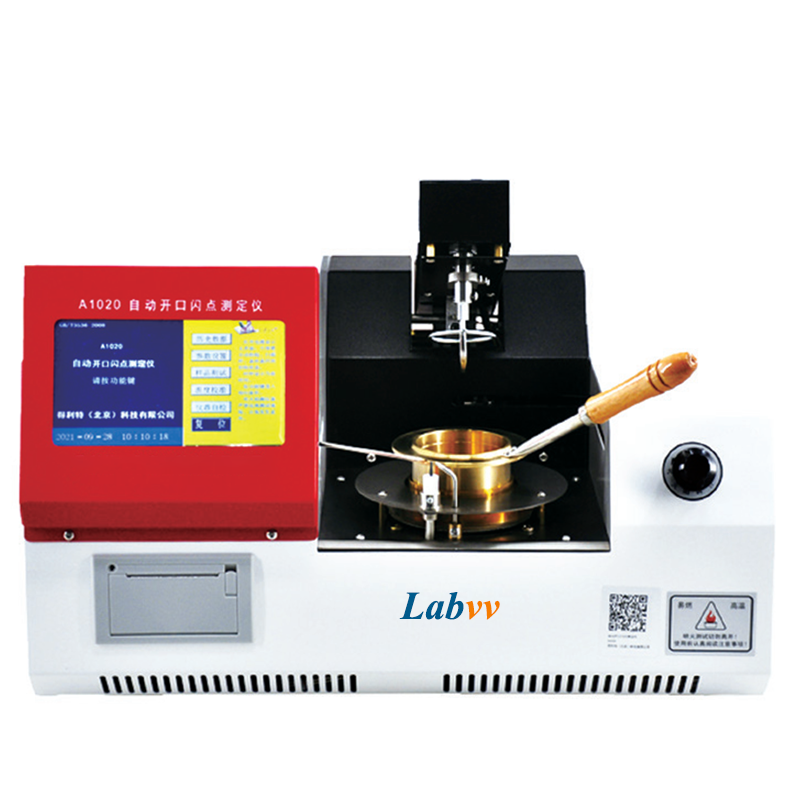
| A1020 | ASTM D92 | Open cup | Automatic Cleveland open cup for heavy fuel oils |
| A1194 | ASTM D3278 | Closed cup (micro) | Rapid low-temperature testing with small sample volume |
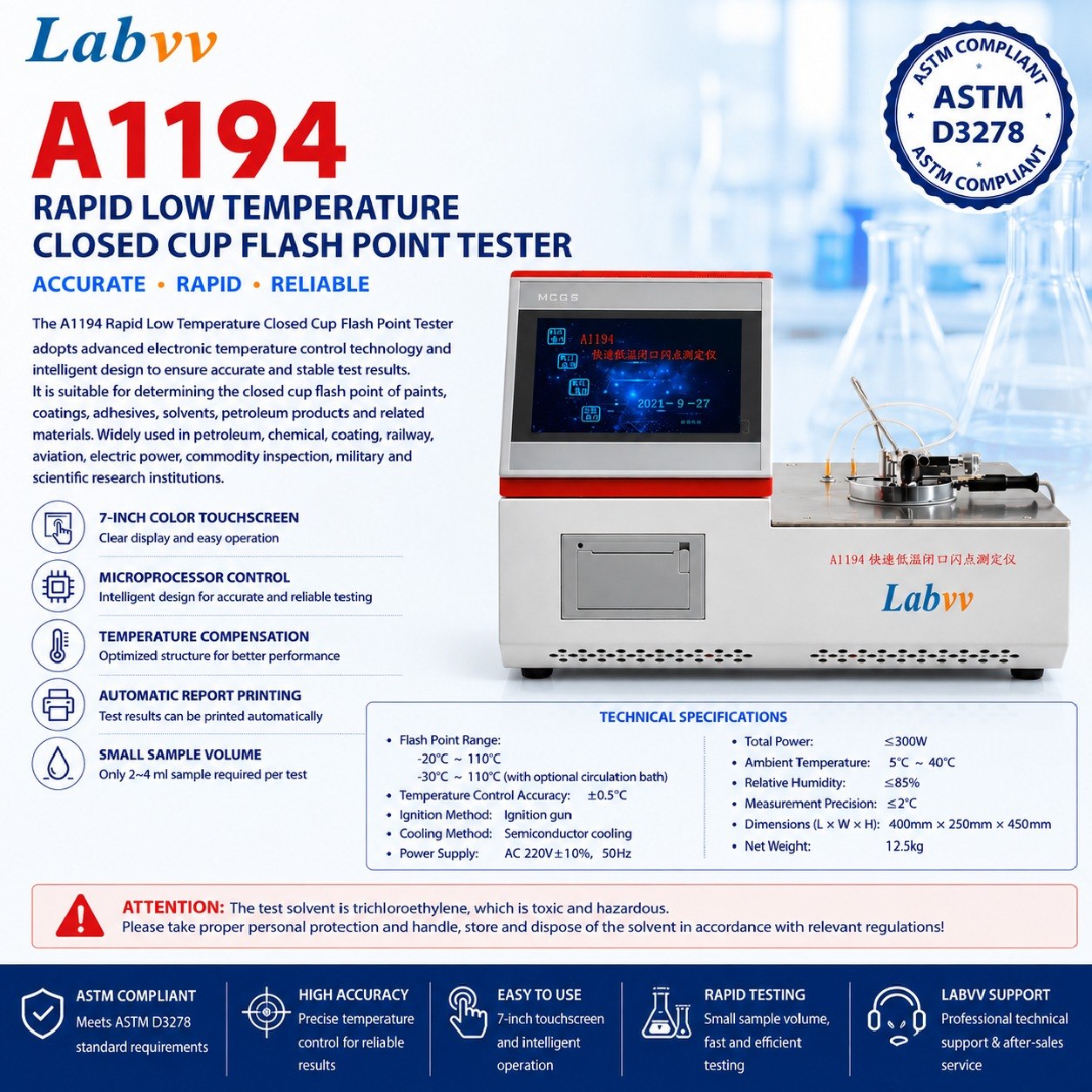
All LabVV flash point testers ship with compliance documentation and are supported with installation guidance, operator training and calibration services. If you are replacing an existing instrument, our team can help you confirm that the new tester matches your current test methods and reporting requirements before you commit.
If you are setting up a new fuel laboratory, also review our closed cup flash point tester buyer’s guide and the general flash point testing guide for a full comparison of methods and equipment. Budget planning is covered in the flash point tester price guide.
Where Diesel Flash Point Testing Is Used
- Refineries and blending plants — release testing of diesel and gas oil batches before dispatch.
- Fuel quality control laboratories — routine verification against national specifications.
- Marine bunker suppliers — checking fuel oil compliance with ISO 8217 and port requirements.
- Biodiesel and renewable fuel plants — flash point control for FAME and blended products.
- Third-party inspection and verification labs — independent testing for traders, importers and customs.
- Fuel storage and distribution terminals — incoming and outgoing quality checks on every transfer.
- Government and customs laboratories — enforcement testing against national fuel quality regulations.
In every one of these settings, the flash point result is recorded on certificates that accompany the product. An accurate, compliant tester is therefore not an optional purchase — it is part of the quality system itself.
Fuel blending deserves special attention. When a blender combines diesel with biodiesel, additives or recycled fractions, the flash point of the blend can shift unpredictably. Routine closed cup testing of each blend batch is the only reliable way to confirm that the finished product still meets its minimum flash point specification before it leaves the plant.
Practical Tips for Reliable Flash Point Results
- Take samples in clean, sealed containers and test promptly — light ends evaporate quickly and raise the measured flash point.
- Never reuse sample cups without thorough cleaning; residual solvent is the most common cause of false low readings.
- Keep the tester calibrated according to the manufacturer’s schedule and verify with certified reference oils.
- Run the test in a well-ventilated area and follow the standard’s heating rate — rushing the ramp is a frequent source of error.
- For very low flash point samples, choose a rapid micro method such as ASTM D3278 to minimise vapour loss.
How to Choose a Flash Point Tester for Your Fuel Laboratory
When selecting equipment for diesel and fuel oil testing, work through this checklist:
- Confirm the standards you must meet — diesel release testing normally means ASTM D93 closed cup; heavy fuel oil means ASTM D92 open cup; rapid screening means ASTM D3278/D3828.
- Choose the cup type — closed cup, open cup, or both. Many fuel QC labs operate one of each.
- Automation level — automatic testers remove operator variation, speed up the workflow and produce digital records; manual units are cheaper but more labour-intensive.
- Temperature range — make sure the instrument covers the flash point range of the products you actually test, including winter grades and heavy fuel oils.
- Sample volume — rapid micro methods need only a few millilitres, which matters for field samples and expensive or hazardous products.
- Data and compliance — check for audit-ready reporting, calibration management and traceability to support ISO 17025 accreditation.
A practical way to compare options is to map your product grades to their test methods first, then match the instrument’s specification to the method. The complete flash point tester buyer’s guide walks through this decision in detail, including open cup vs closed cup trade-offs and total cost of ownership.
Frequently Asked Questions
What is the flash point of diesel fuel?
Most national specifications require diesel to have a minimum flash point of around 52–60 °C by the Pensky-Martens closed cup method (ASTM D93). Actual values vary by grade and climate.
Why is diesel flash point tested?
It is a safety parameter that governs storage and transport classification, and it also detects contamination with gasoline or other light fractions.
Should diesel be tested with D93 or D92?
Diesel is tested with ASTM D93 (closed cup). ASTM D92 (open cup) is used for high-flash heavy fuel oils and lubricants.
What is the difference between flash point and fire point?
Flash point is the lowest temperature at which vapours ignite briefly; fire point is the temperature at which the liquid sustains combustion. Fire point is always higher than flash point.
Can one tester do both closed cup and open cup testing?
No — closed cup and open cup methods use different apparatus. Laboratories testing both diesel and heavy fuel oils typically need two instruments, such as the A1190 and A1020.
How often should a flash point tester be calibrated?
Follow the manufacturer’s schedule (typically every 6–12 months) and verify performance with certified reference materials between calibrations.
What is the minimum flash point for marine fuel oil?
SOLAS and ISO 8217 require marine fuel oils to have a flash point of at least 60 °C by the closed cup method. This requirement exists to reduce fire risk on board ships.
Can diesel flash point change during storage?
Yes. Contamination with lighter products lowers the flash point, while evaporation of light ends over long storage periods can raise it. Regular retesting is recommended for stored product.
How much sample is needed for rapid flash point methods?
Rapid micro methods such as ASTM D3278 require only a few millilitres of sample, which is useful when sample volume is limited — for example in field testing or small batch QC.
Is flash point the same as auto-ignition temperature?
No. Flash point requires an external ignition source; auto-ignition temperature is the temperature at which the vapour ignites on its own. Auto-ignition temperature is always much higher.
Need a Flash Point Tester for Your Fuel Laboratory?
LabVV supplies automatic closed cup and open cup flash point testers with full after-sales support. Send us your testing requirements for a quotation.