Cold-flow performance decides whether a diesel fuel pumps in a Siberian winter, whether a lubricating oil circulates in a Canadian pipeline, and whether a crude cargo can be offloaded in the North Sea. The laboratory test that quantifies all three is the pour point test, governed by ASTM D97 (manual) and ASTM D7500 (automated).
This guide explains what pour point means, how the two ASTM methods work, where they differ, and how to choose an automatic pour point tester for your laboratory. If you are evaluating equipment for diesel, lube oil, or crude analysis, this is the reference you need before you issue an RFQ.
🔬 What Is Pour Point and Why Does It Matter?
Pour point is the lowest temperature at which a petroleum product will still pour or flow when cooled under defined laboratory conditions. Below this temperature, the sample stops moving — wax crystals precipitate, the oil structure solidifies, and pumps, filters, and injectors lose suction.
Pour point is one of the most frequently specified cold-flow properties in the industry because it predicts real-world operability:
- ✅ Diesel fuel — low pour point means reliable cold-start and no fuel starvation in winter climates (Europe, North America, Russia, Kazakhstan)
- ✅ Lubricating oils — gear oils, engine oils, and hydraulic fluids must stay pumpable at minimum ambient temperature
- ✅ Crude oil — waxy crudes can solidify in pipelines and tanks; pour point drives flow-assurance decisions and additive dosing
- ✅ Fuel oils & marine bunkers — storage, transfer, and atomization all depend on pour behavior
- ✅ Base oils — refiners use pour point as a key quality gate for base oil grades
The pour point is always reported together with the cloud point (the temperature at which wax first becomes visible) — together they describe the complete low-temperature picture of a product.
⚖️ ASTM D97 vs ASTM D7500: Two Methods, One Goal
Both standards determine pour point, but they use fundamentally different measurement principles. The table below compares them head-to-head.
| Parameter | ASTM D97 (Manual) | ASTM D7500 (Automated) |
|---|---|---|
| Method principle | Manual visual inspection after cooling in a bath | Automated pressure-pulse (air or nitrogen) detection |
| Sample volume | 45–50 mL per test jar | Same test jar geometry, instrument-controlled |
| Cooling | Sequential water/ice/solid-CO₂ baths (manual transfer) | Programmable multi-stage cooling in one chamber |
| Detection | Operator tilts the jar and observes whether the surface moves | Pressure pulse applied to the sample surface; movement detected automatically |
| Test interval | 3 °C (5 °F) steps per the standard | Same 3 °C (5 °F) steps, executed automatically |
| Operator involvement | Continuous — one test can take several hours of supervision | Load sample, press start, walk away |
| Repeatability | Depends heavily on operator judgment | Instrument-defined, removing human variability |
| Typical report | Pour point in °C or °F | Pour point + optional cloud point, logged digitally |
⚠️ Key point for buyers: ASTM D7500 was introduced specifically to automate the D97 procedure. Laboratories that run high sample volumes — fuel terminals, blending plants, refineries, and third-party testing labs — are rapidly migrating to automated instruments because D97’s manual method is labor-intensive and operator-sensitive.
📋 ASTM D97 Manual Test Procedure: Step by Step
Understanding the manual method helps you appreciate what an automatic tester replaces — and how to validate automated results against the reference method.
Step 1 — Sample Preparation
Pour 45–50 mL of the sample into a clean, dry test jar. Heat waxy samples above their expected pour point (usually to 45 °C or higher) to dissolve any prior wax structure, then cool back down under controlled conditions. This thermal history matters — it is part of what makes the test repeatable.
Step 2 — Preliminary Pour Point
Perform a quick preliminary test to estimate the range. The sample is cooled in a bath and inspected every 3 °C (5 °F) until it stops pouring. The recorded preliminary pour point is used to choose the correct starting temperature for the definitive test — per the standard’s Table 1, the definitive test must start at least 12 °C above the expected pour point.
Step 3 — Definitive Test
The sample is placed in the appropriate bath (water bath, ice bath, or solid-CO₂ bath depending on the expected range). At each 3 °C (5 °F) increment, the jar is removed, tilted, and the operator observes whether the surface moves within 5 seconds. The pour point is recorded as 3 °C (5 °F) above the temperature at which the sample fails to pour.
Step 4 — Reporting
Results are reported in whole degrees Celsius (or Fahrenheit), typically to the nearest 3 °C increment. The method’s repeatability for most products is ±3 °C, and reproducibility is ±6 °C — so two laboratories testing the same sample should agree within 6 °C.
🤖 How ASTM D7500 Automates the Pour Point Test
ASTM D7500 — Standard Test Method for Determination of Pour Point of Petroleum Products by Automatic Pressure Pulsing — keeps the D97 test philosophy but replaces the human eye with a pressure sensor.
Here is how a modern automatic pour point tester works:
- 🔹 The sample is placed in the standard test jar inside a temperature-controlled chamber
- 🔹 The chamber cools the sample in programmed 3 °C (5 °F) steps from above the expected pour point
- 🔹 At each step, a small pulse of air (or nitrogen) is applied to the sample surface
- 🔹 A pressure sensor detects whether the surface moves — if it moves, the sample still pours; if it does not, the pour point has been reached
- 🔹 The instrument records the result automatically and prints or exports the report
Because detection is mechanical rather than visual, D7500 instruments eliminate the largest source of D97 variability: the operator. One technician can run multiple instruments simultaneously, overnight tests become routine, and audit trails are built into the software.
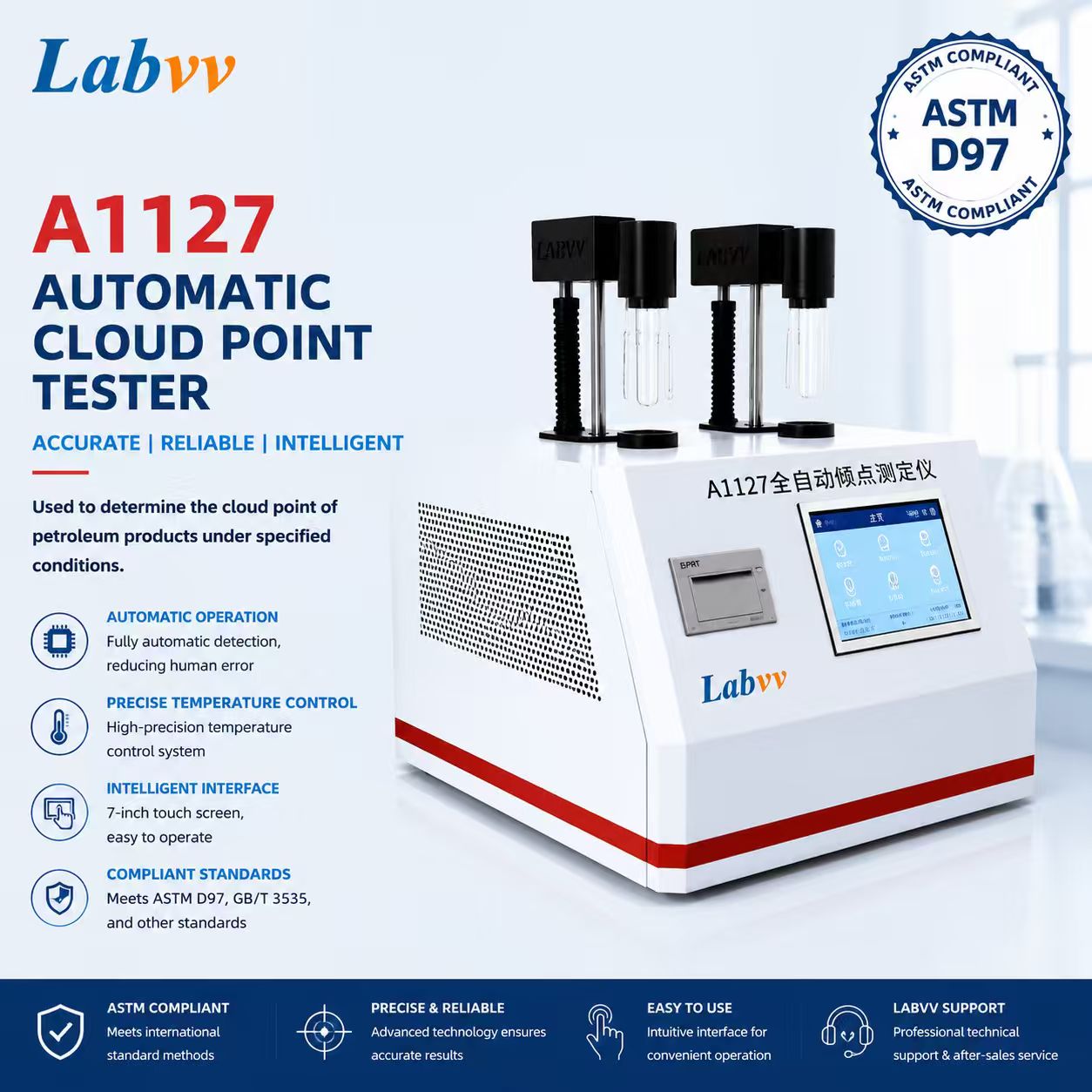
The LabVV A1127 Automatic Pour Point Tester follows exactly this principle: pressure-pulse detection, multi-stage cooling down to −70 °C, and full compliance with ASTM D97 and D7500 requirements.
🛢️ Where Pour Point Testing Is Mandatory: Applications
Pour point is specified in a wide range of quality control and regulatory programs. Knowing the applications helps you size your instrument correctly and justify the investment.
Diesel and Automotive Fuel Testing
Winter-grade diesel specifications (EN 590, GOST R 52368, and national cold-flow programs) include pour point alongside CFPP and cloud point. Fuel terminals and blending plants test every batch in the cold season to avoid blocked filters and stranded vehicles.
Lubricating Oil and Grease Testing
Engine oils, gear oils, hydraulic fluids, and turbine oils all list pour point on their data sheets. Low-temperature pumpability is a direct function of pour point, and OEM approvals (API, ACEA, JASO) require documented cold-flow performance.
Crude Oil and Flow Assurance
Waxy crudes from the Middle East, West Africa, and China’s offshore fields are notorious for pour point issues. Pipeline operators use pour point data to set heating requirements, decide on pour-point-depressant (PPD) dosing, and schedule pigging operations.
Fuel Oils, Marine Bunkers and Base Oils
ISO 8217 marine fuels, heavy fuel oils, and base oil grades all carry pour point limits. For base oils, pour point directly correlates with the VI and wax content of the finished lubricant.
✅ How to Choose an Automatic Pour Point Tester
If your laboratory runs more than a handful of pour point tests per week, an automatic tester pays for itself quickly. Use this checklist when evaluating instruments:
- ✅ Temperature range — confirm the low end covers your products. Diesel and lube oils typically need −35 °C to −40 °C; crude and Arctic grades need −60 °C to −70 °C
- ✅ Method compliance — verify ASTM D97 and D7500 compliance, plus ISO 3016 and GB/T 3535 if you serve international or Chinese markets
- ✅ Cloud point capability — a combined pour + cloud point tester (ASTM D2500 / IP 389) saves a second instrument purchase
- ✅ Detection system — pressure-pulse detection is the proven D7500 approach; optical systems are an alternative for cloud point
- ✅ Automation level — look for multi-bath or multi-position designs that run several samples unattended overnight
- ✅ Data management — built-in LIMS export, audit trails, and printable reports reduce paperwork and satisfy ISO 17025 record requirements
- ✅ Cooling technology — compressor-based cooling avoids the cost and hassle of liquid nitrogen or dry ice for most applications
- ✅ Calibration and support — check the supplier’s calibration procedure, reference standards, and after-sales response time in your region
Two Proven Options from LabVV
LabVV offers two pour point instruments that cover the full range of laboratory needs:
| Model | Best For | Key Features |
|---|---|---|
| A1127 Automatic Pour Point Tester | Fuel, lube, and crude laboratories needing automated D97/D7500 testing | Pressure-pulse detection, −70 °C range, multi-stage cooling, automatic reporting |
| A1121 Pour Point & Cloud Point Tester | Labs that must report both cold-flow properties from one instrument | Combined pour + cloud point per ASTM D97/D2500, dual-function design |
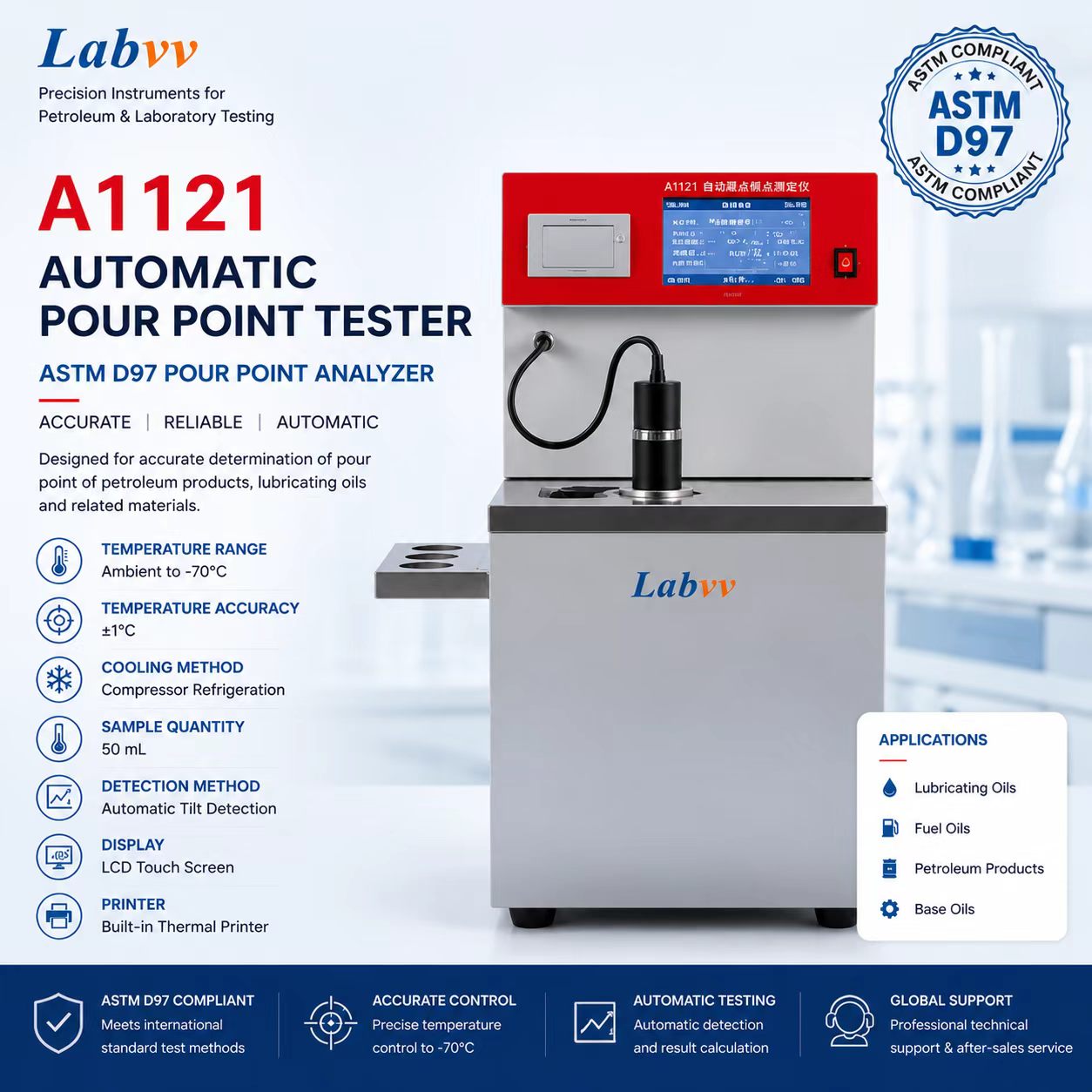
Both instruments are built to the same standards that govern your product specifications — and both are backed by LabVV’s global support network for installation, training, and calibration.
📊 Pour Point Test Data at a Glance
Quick-reference numbers every lab manager should have on hand:
| Property | Typical Value |
|---|---|
| Sample volume (D97) | 45–50 mL |
| Test step | 3 °C (5 °F) |
| Repeatability (D97) | ±3 °C |
| Reproducibility (D97) | ±6 °C |
| Typical diesel pour point | −15 °C to −35 °C (winter grade) |
| Typical lube oil pour point | −18 °C to −45 °C |
| Waxy crude pour point | +15 °C to +35 °C (before PPD treatment) |
| Automatic tester range (A1127) | Ambient to −70 °C |
❓ Pour Point Testing FAQ
What is the difference between pour point and cloud point?
Cloud point is the temperature at which wax crystals first become visible as the sample cools — the product is still fully fluid. Pour point is the lower temperature at which the sample stops pouring altogether. Cloud point always occurs above pour point for the same product.
Can ASTM D7500 replace ASTM D97?
Yes, for routine testing. D7500 was designed as an automated equivalent of D97 using pressure-pulse detection. Many specifications accept either method, but always confirm with your customer or specification which method is required — some contracts still mandate D97 as the referee method.
How long does a pour point test take?
A manual D97 test typically takes 2–4 hours of operator time because of the sequential baths and constant observation. An automatic D7500 tester runs the same test unattended, so operator time drops to minutes — load the sample, start the program, and collect the result later.
What temperature range do I need for my pour point tester?
Match the instrument to your coldest product. Diesel and most lube oils: −35 °C to −40 °C is enough. Arctic diesel, aviation-related oils, and waxy crudes: choose a −60 °C or −70 °C model like the A1127 so you never have to reject a sample for lack of range.
Why do I need both cloud point and pour point data?
Cloud point tells you when wax starts to form (important for filter plugging in diesel), while pour point tells you when the product becomes unpumpable (important for storage and transfer). Specifications for winter fuels and low-temperature lubricants commonly require both values.
📌 Conclusion
Pour point is a small test with outsized consequences — it decides whether fuel flows, pumps turn, and pipelines keep running in cold weather. ASTM D97 defines the reference procedure; ASTM D7500 automates it for the modern laboratory. Whether you are upgrading a manual station or building a new petroleum testing lab, an automatic pour point tester is one of the fastest-ROI instruments you can add.
For a complete cold-flow testing solution, pair your pour point tester with related ASTM petroleum testing equipment — and talk to LabVV about a system that covers your full specification list.
Need help selecting the right pour point tester for your application? Our engineers will match the instrument to your products, standards, and sample volumes.