
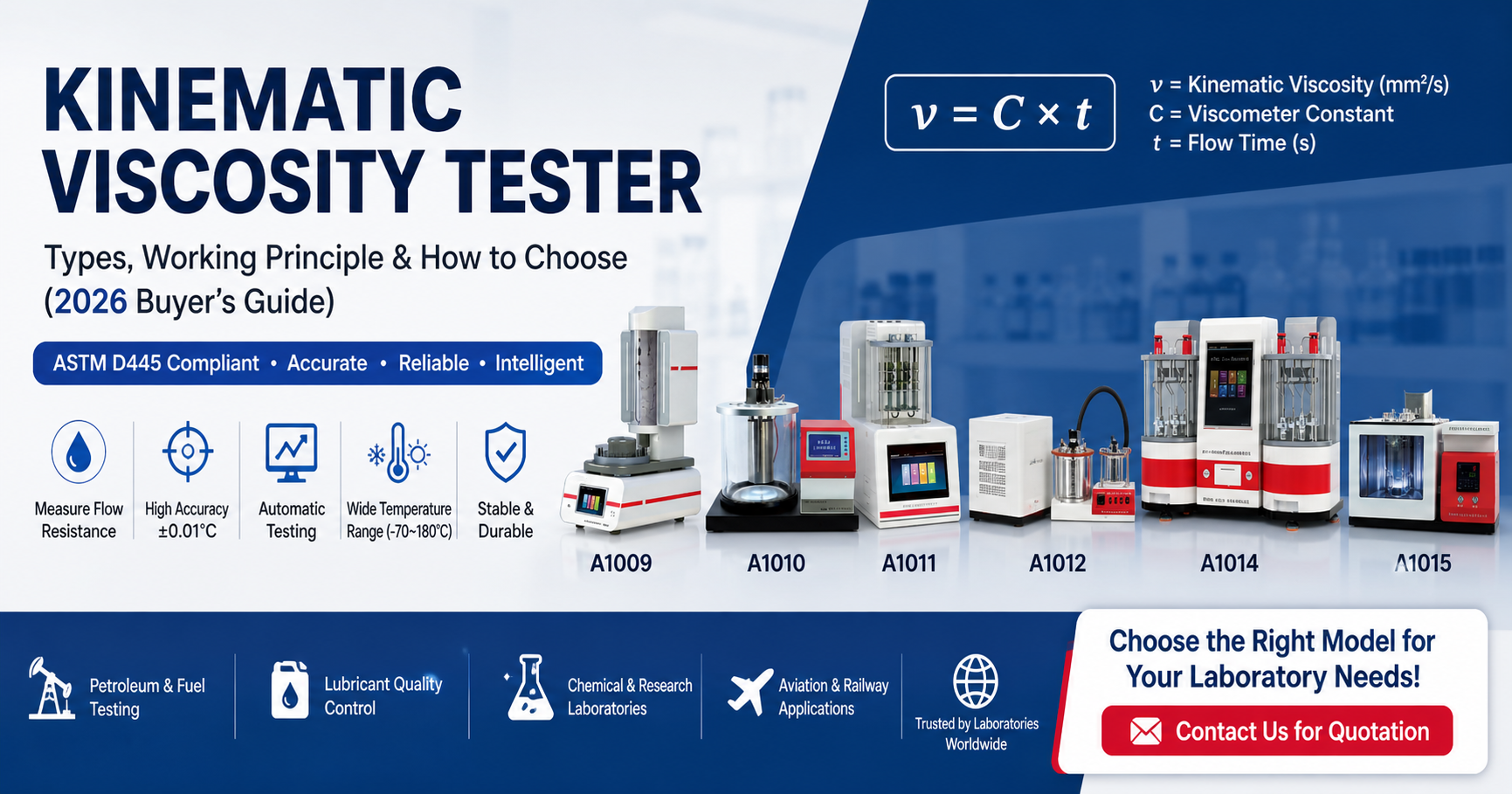
Kinematic viscosity is one of the most critical parameters in petroleum and lubricant testing. Whether you are operating an oil laboratory, managing refinery quality control, or sourcing equipment for distribution, selecting the right viscosity tester directly impacts your testing accuracy, efficiency, and business competitiveness.
In this guide, we’ll walk you through:
- What a kinematic viscosity tester is
- How it works (ASTM D445 principle)
- Different types and model comparisons
- How to choose the right equipment
- Key features buyers care about
1. What is a Kinematic Viscosity Tester?
A kinematic viscosity tester is a laboratory instrument used to measure the flow resistance of liquids under gravity. It is widely used for testing:
- Lubricating oils
- Diesel and fuel oils
- Hydraulic fluids
- Chemical liquids
👉 In simple terms:
Higher viscosity = slower flow
For a full product range, you can explore:
👉 Kinematic Viscosity Category:
https://labvv.com/product-category/petroleum-testing-equipment/kinematic-viscometer/
2. Working Principle (ASTM D445 Explained)
Kinematic viscosity testing is based on the capillary method, standardized under ASTM D445.
ν=C⋅t\nu = C \cdot tν=C⋅t
Where:
- ν = kinematic viscosity (mm²/s or cSt)
- C = viscometer constant
- t = flow time (seconds)
How the test works:
- The sample is placed into a glass capillary tube
- The system stabilizes temperature (e.g., 40°C or 100°C)
- The liquid flows under gravity
- Sensors measure flow time automatically
- The system calculates viscosity
💡 Key insight:
Accuracy depends heavily on:
- Temperature control precision
- Timing accuracy
- Capillary calibration
3. Types of Kinematic Viscosity Testers (Model Comparison)
Based on automation level and application, viscosity testers can be divided into several categories:
1. Basic / Entry-Level Model
👉 A1010 Kinematic Viscometer
https://labvv.com/product/a1010-kinematic-viscometer/
Features:
- Manual or semi-automatic operation
- PID temperature control
- Cost-effective solution
Best for:
- Small laboratories
- Budget-sensitive buyers
2. Standard Automatic Models
👉 A1011 Automatic Kinematic Viscometer (ASTM D445)
https://labvv.com/product/a1011-automatic-kinematic-viscometer/
👉 A1009 Automatic Kinematic Viscometer (ASTM D445, ASTM D446)
https://labvv.com/product/a1009-astm-d445-automatic-kinematic-viscometer/
Features:
- Automatic timing and calculation
- Stable temperature system
- Optional data storage
Best for:
- Petroleum labs
- Lubricant manufacturers
- Distributors targeting mid-range market
3. Low Temperature Viscosity Tester
Model: A1012
Features:
- Temperature range down to -70°C
- Compressor refrigeration system
Best for:
- Aviation fuel testing
- Cold environment oils
4. High Temperature Viscosity Tester
Model: A1015
Features:
- Temperature up to 180°C
- High-temperature oil bath
Best for:
- Heavy oil testing
- Asphalt and polymer materials
5. Fully Automatic High-End System
👉 A1014 Automatic Capillary Viscometer
https://labvv.com/product/a1014-automatic-capillary-viscometer-astm-d7279/
Features:
- Automatic sampling, cleaning, drying
- Multi-sample testing
- LIMS compatibility
Best for:
- Government labs
- Large-scale testing centers
- High-end buyers
💡 This model has the highest conversion potential due to automation and efficiency.
4. Key Features Buyers Should Focus On
1. Temperature Control Accuracy
- ±0.01°C → high precision
- ±0.1°C → standard
👉 Directly impacts test results
2. Automation Level
- Manual → low cost
- Semi-automatic → balanced
- Fully automatic → high efficiency
3. Measurement Range
Typical:
- 0.5 ~ 5000 mm²/s
Extended: - Up to 10000 mm²/s
4. Cooling System
- Air cooling → basic use
- Compressor cooling → low temperature testing
5. Cleaning System
- Manual cleaning → low cost
- Automatic cleaning → saves labor
💡 Strong selling point for distributors and large labs
5. How to Choose the Right Kinematic Viscometer
Step 1 – Temperature Requirement
- Standard oils → A1009 / A1011
- Low temperature → A1012
- High temperature → A1015
Step 2 – Budget
- Low → A1010
- Medium → A1011
- High → A1014
Step 3 – Automation Needs
- Basic → A1010
- Semi-auto → A1009
- Fully automatic → A1014
Step 4 – Throughput
- Small workload → standard models
- High volume → fully automatic
6. Application Industries
Kinematic viscosity testers are essential in:
- Oil & gas industry
- Lubricant production
- Power plants
- Railway systems
- Aerospace fuel testing
- Chemical laboratories
7. Complete Lab Setup (Internal Resource)
If you are planning a full laboratory, check:
👉 Petroleum Testing Laboratory Setup
https://labvv.com/petroleum-testing-laboratory-setup/
👉 Complete Petroleum Laboratory Equipment List
https://labvv.com/petroleum-laboratory-equipment-list/
👉 Oil Analysis Equipment Guide
https://labvv.com/oil-analysis-equipment/
8. Why This Equipment Has Strong Global Demand
This product category is highly demanded because:
- Required by international standards (ASTM D445)
- Used in almost all oil labs
- Repeat purchase demand
- Consumables needed (capillary tubes, solvents)
👉 Strong markets include:
- Middle East
- Africa
- Southeast Asia
9. Common Buyer Questions
Before purchasing, buyers usually ask:
- Is ASTM D445 compliant?
- Is calibration included?
- Does it support LIMS?
- Is cleaning automatic?
- What is the delivery time?
👉 Answering these clearly increases conversion rate significantly.
10. Why Choose LabVV
👉 Reliable Laboratory Equipment Supplier
https://labvv.com/petroleum-testing-equipment/
- Complete product range (basic → high-end)
- OEM & customization support
- Competitive factory pricing
- Export experience in global markets
- Fast technical support
11. Get a Quote / Become a Distributor
Looking for a reliable kinematic viscosity tester supplier?
Contact us today for:
- Quotation
- Technical consultation
- Product catalog
- Distributor partnership
🌐 https://labvv.com
📧 sophie@labvv.com
📱 WhatsApp: +86 13560386440
Have questions or need expert guidance?
Reach out to our Labvv team !