
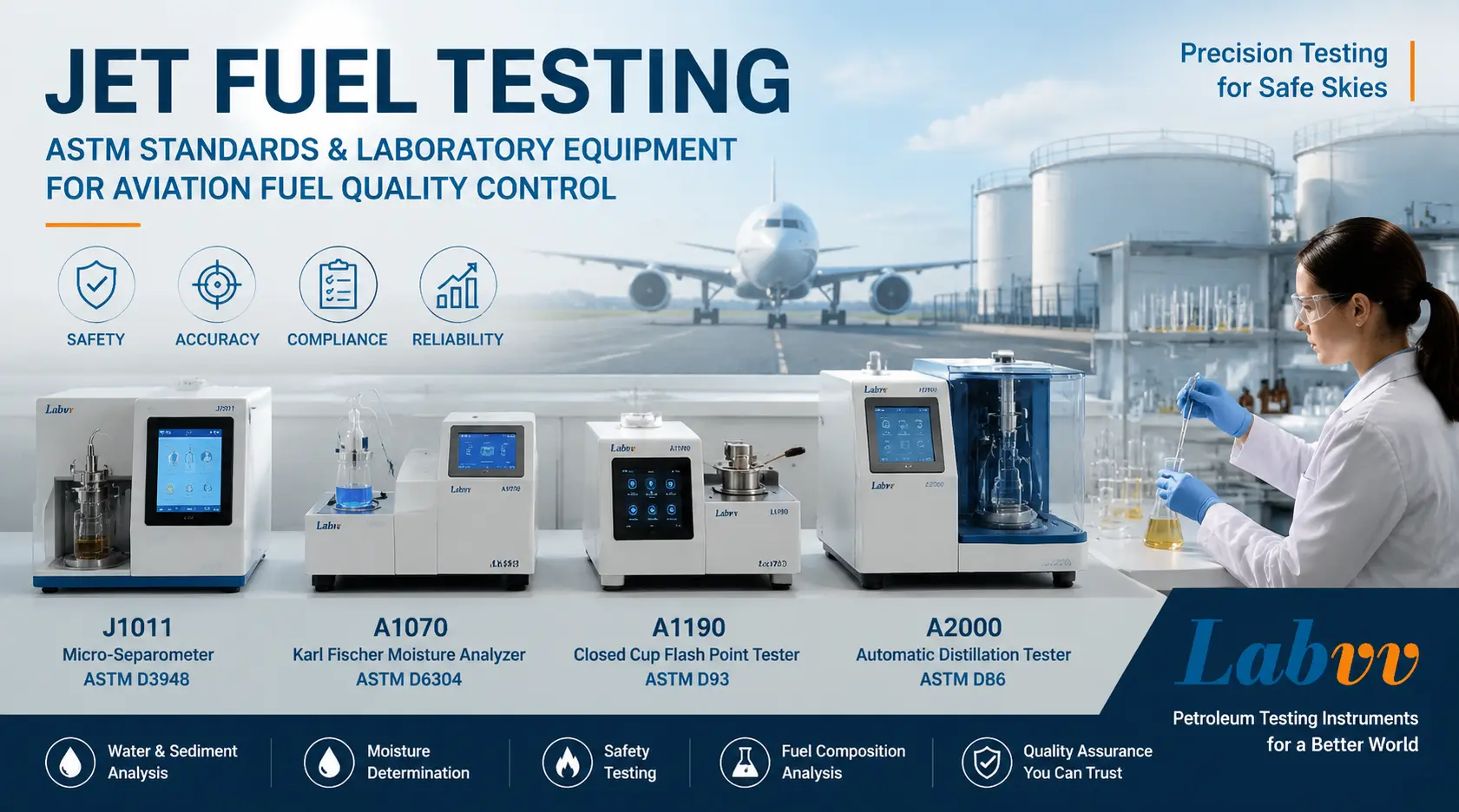
Aviation fuel quality control is essential for ensuring safe aircraft operation and reliable fuel performance. Laboratories worldwide use standardized ASTM testing methods to evaluate critical properties of jet fuel before storage, distribution, and use. This guide covers the key ASTM standards, testing equipment, and best practices for aviation fuel testing laboratories.
🔬 Why Jet Fuel Testing Is Important
Jet fuel quality directly impacts aircraft safety, engine performance, and operational reliability. Contaminated or off-specification fuel can cause engine failures, injector fouling, ice formation in fuel lines, and microbial growth in storage tanks. Rigorous testing at every stage — from refinery to wing — is mandatory under international aviation safety standards.
An aviation fuel laboratory performs routine quality control tests to verify that jet fuel meets specifications such as ASTM D1655 (Standard Specification for Aviation Turbine Fuels) and DEF STAN 91-91. These tests evaluate critical parameters including water separation characteristics, moisture content, flash point, and distillation range.
For airlines, fuel suppliers, and defense organizations, investing in reliable fuel testing equipment and maintaining rigorous jet fuel quality control protocols is not just a regulatory requirement — it is a fundamental safety imperative.
⚙️ Key ASTM Standards for Aviation Fuel Testing
Several ASTM standards govern the testing of aviation turbine fuels. Each addresses a specific property critical to fuel performance and safety.
ASTM D3948 — Water Separation Index Test
The water separation index (WSI) test evaluates the ability of jet fuel to release entrailed water. This is critical because free water in fuel can cause icing, microbial growth, and corrosion in fuel systems.
ASTM D3948 uses a micro-separometer to measure how readily a fuel sample separates from water after passing through a coalescing filter. A high WSI value indicates good water separation characteristics.
The LabVV J1011 Micro-Separometer provides precise, automated WSI measurement in full compliance with ASTM D3948, featuring a user-friendly touch screen interface and integrated data logging for audit-ready results.
View LabVV J1011 Micro-Separometer →
ASTM D6304 — Karl Fischer Moisture Analysis
Trace water content in jet fuel must be tightly controlled. Even small amounts of dissolved water can cause issues at high altitude where low temperatures lead to ice crystal formation.
ASTM D6304 specifies the Karl Fischer coulometric titration method for measuring trace water content in petroleum products, including aviation fuels. This method can detect water down to the parts-per-million (ppm) level with high accuracy and repeatability.
The LabVV A1070 Automatic Coulometric Karl Fischer Moisture Analyzer offers laboratory professionals a reliable, automated solution for ASTM D6304 moisture analysis, with a detection range from 1 ppm to 100% water content.
View LabVV A1070 Moisture Analyzer →
ASTM D93 — Flash Point Testing
Flash point is a critical safety parameter for jet fuel classification, storage, and transportation. ASTM D93 (Pensky-Martens Closed Cup) determines the lowest temperature at which the fuel vapors ignite when exposed to an ignition source.
Jet fuel typically has a flash point above 38 °C (100 °F), and maintaining this property within specification is essential for safe handling. The LabVV A1190 Automatic Pensky-Martens Flash Point Tester delivers precise, automated flash point measurement in compliance with ASTM D93, with a temperature range covering ambient to 370 °C.
View LabVV A1190 Flash Point Tester →
ASTM D86 — Distillation Testing
Distillation characteristics determine the boiling range of jet fuel, which affects engine starting, combustion efficiency, and fuel system performance. ASTM D86 is the standard test method for distillation of petroleum products at atmospheric pressure.
The distillation profile of jet fuel must meet strict initial boiling point (IBP), 10%, 50%, 90%, and final boiling point (FBP) specifications. The LabVV A2000 Automatic Distillation Tester performs automated ASTM D86 distillation testing with precise temperature tracking and data recording.
View LabVV A2000 Distillation Tester →
📊 Aviation Fuel Testing Methods and Instruments
Below is a summary of the key ASTM test methods for jet fuel quality control, along with the corresponding LabVV instruments:
✅ Building a Complete Aviation Fuel Laboratory
For laboratories looking to establish or upgrade a jet fuel testing facility, a comprehensive approach to equipment selection is essential. Beyond the four core ASTM tests above, aviation fuel laboratories typically also require:
- 🔹 Particulate contamination analysis — ASTM D2276, D5452
- 🔹 Electrical conductivity testing — ASTM D2624
- 🔹 Copper strip corrosion testing — ASTM D130
- 🔹 Thermal stability testing — ASTM D3241 (JFTOT)
- 🔹 Water and sediment testing — ASTM D2709, D4007
LabVV offers a complete range of ASTM-compliant petroleum testing instruments, enabling laboratories to source all their fuel testing equipment from a single trusted manufacturer.
📌 Need Reliable Aviation Fuel Testing Equipment?
LabVV provides ASTM-compliant petroleum testing instruments for aviation fuel laboratories, refineries, research institutions, and quality control departments worldwide.
Contact LabVV for product selection, technical specifications, and OEM solutions tailored to your laboratory’s requirements.