
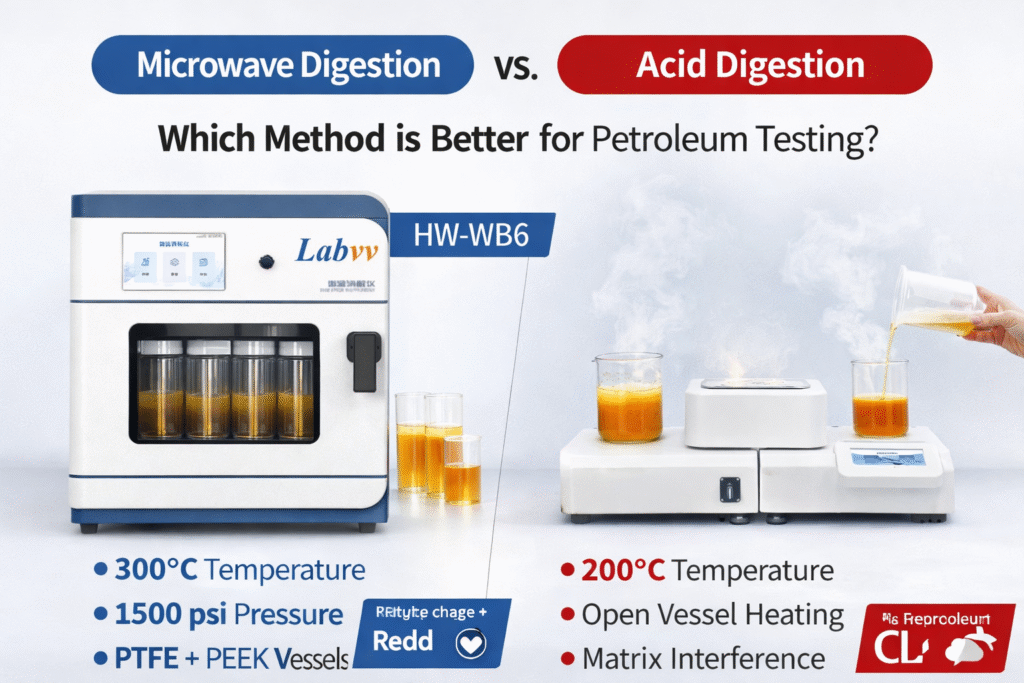
Microwave Digestion vs Acid Digestion in Petroleum Testing: Which Method is Better?
In petroleum laboratories, sample preparation quality directly affects ICP-OES and ICP-MS accuracy.
Many procurement managers, refinery laboratories, and third-party testing labs still struggle with:
- incomplete digestion of crude oil and sludge
- unstable nickel and vanadium recovery
- long acid digestion cycles delaying reporting
- safety risks from open hot-plate digestion
- difficulty finding a reliable laboratory equipment supplier with stable quality and fast lead times
This is why more laboratories are replacing traditional hot-plate methods with microwave digestion acid digestion workflow upgrades.
For crude oil, lubricants, residual fuel, waste oil, and petrochemical sludge, microwave digestion offers:
- faster oxidation
- higher pressure reaction efficiency
- lower residual carbon
- better repeatability
- safer closed-vessel operation
A practical example is the HW-WB6 Microwave Digestion System, specifically suitable for petroleum sample preparation with:
- 0–1800W industrial-grade magnetron
- 300°C max digestion temperature
- 1500 psi (≈10 MPa) high-pressure vessels
- 6-vessel batch capacity
- 360° continuous rotation
- PTFE inner vessels + PEEK outer jackets
👉 Need a 300°C petroleum microwave digestion system?
Request full specifications and factory pricing today.
Why Microwave Digestion Is Better for Petroleum Testing
1) Higher Temperature for Heavy Hydrocarbon Samples
Traditional acid digestion is limited by open-vessel boiling points.
The HW-WB6 reaches 300°C, enabling complete oxidation of:
- crude oil
- heavy fuel oil
- lubricating additives
- refinery sludge
- catalyst residues
This significantly improves trace metal recovery for Ni, V, Fe, Ca, and Zn.
2) Higher Pressure for Complete Digestion
Petroleum samples require pressure to break down carbon-rich matrices.
The HW-WB6 supports:
- 1500 psi pressure
- reinforced threaded sealing
- individual vessel pressure relief
This makes it highly suitable for:
- ICP-OES trace metals
- ICP-MS contamination analysis
- additive formulation testing
- refinery QC workflows
3) Faster Throughput for Commercial Labs
Throughput directly impacts lab ROI.
The 6-vessel batch rotor allows multiple petroleum samples in one cycle, making it ideal for:
- refinery laboratories
- environmental labs
- OEM lab projects
- third-party testing centers
Compared with traditional acid digestion, labs can often reduce preparation time by 60–80%.
4) Better Sample Consistency
Traditional hot-plate digestion often causes uneven heating.
The HW-WB6 solves this through:
- 360° continuous unidirectional rotation
- uniform microwave distribution
- excellent parallel digestion repeatability
This is critical for batch release and commercial testing labs.
5) Advanced Safety for Strong Acid Systems
Safety is one of the biggest reasons buyers upgrade.
The HW-WB6 includes:
- self-locking explosion-proof safety door
- dual pressure relief protection
- electromagnetic interlock
- automatic microwave shutdown
- real-time temperature + pressure monitoring
- corrosion-resistant exhaust cooling
This dramatically reduces operator risk.
6) Lower Long-Term Operating Cost
Although initial CAPEX is higher, microwave digestion reduces:
- labor time
- acid waste
- repeat digestion
- failed ICP batches
- contamination reruns
For B2B buyers, this means better factory-price ROI over 2–3 years.
HW-WB6 vs Traditional Entry-Level Systems
| Parameter | HW-WB6 | Standard Entry-Level |
|---|---|---|
| Batch Capacity | 6 vessels | 4 vessels |
| Max Temperature | 300°C | 220–240°C |
| Max Pressure | 1500 psi | 800–1000 psi |
| Vessel Material | PTFE + PEEK | PTFE only |
| Rotation | 360° continuous | intermittent |
| Petroleum Sample Suitability | Excellent | Medium |
👉 Not sure whether 6 vessels is enough for your refinery workflow?
Contact our engineers for a petroleum digestion method recommendation.
Buying Guide: How to Choose the Right Microwave Digestion System
When sourcing a microwave digestion system for petroleum testing, buyers should focus on:
Microwave Output Power
The 0–1800W continuous adjustable output supports different oil viscosities.
Vessel Material
The HW-WB6 uses:
- PTFE inner vessels
- PEEK outer jackets
for superior acid resistance.
Temperature Accuracy
The ±0.5°C infrared non-contact temperature control ensures excellent reproducibility.
Chamber Durability
The 316 stainless steel cavity with Teflon coating is ideal for strong acid environments.
Common Buyer Mistakes
Avoid:
- low-pressure vessels
- insufficient rotor capacity
- poor after-sales support
- suppliers without spare vessel inventory
Application Scenarios
Petrochemical Laboratories
- crude oil trace metals
- fuel additives
- lubricants
- refinery sludge
Environmental Testing
- wastewater
- contaminated soil
- sludge
- hazardous oil waste
Research Institutes
- catalyst studies
- new oil additive development
- petrochemical material R&D
Industrial QC Labs
- incoming oil inspection
- wear metal analysis
- batch release testing
Frequently Asked Questions
Is microwave digestion better than acid digestion for crude oil?
Yes. Microwave digestion provides higher temperature (300°C) and 1500 psi pressure, ensuring more complete oxidation of heavy hydrocarbon matrices.
What is the best microwave digestion temperature for petroleum samples?
For crude oil and lubricant samples, 220–300°C is typically ideal depending on the acid system.
How many vessels are ideal for refinery lab throughput?
A 6-vessel microwave digestion system like HW-WB6 is ideal for most QC and third-party testing labs.
What vessel material is best for strong acid digestion?
PTFE inner vessels with PEEK outer jackets offer the best balance of corrosion resistance and pressure stability.
👉 Need ICP-compatible digestion method suggestions?
Send your sample type now for a free application recommendation.
Why Choose Labvv as Your Guangzhou Laboratory Equipment Supplier
As a reliable laboratory equipment supplier from Guangzhou, China, Labvv provides cost-effective microwave digestion solutions for petroleum, environmental, and industrial laboratories.
Our Core Advantages
- factory-level pricing through supply chain integration
- OEM / ODM branding support
- fast spare vessel supply
- stable export quality control
- global shipping capability
- fast lead times
- professional ICP sample preparation support
- multi-brand sourcing capability
We focus on solution capability and sourcing integration, helping buyers reduce procurement risk.
Recommended Internal Links
Final Recommendation: Which Method Should You Choose?
For modern petroleum elemental analysis, microwave digestion is clearly the better long-term investment.
If your lab requires:
- faster batch release
- higher throughput
- better metal recovery
- stronger safety
- lower rerun rates
then the HW-WB6 Microwave Digestion System is the better choice over traditional acid digestion.
Its 300°C temperature, 1500 psi vessels, 6-place rotor, and intelligent safety control make it ideal for petroleum testing workflows.
🚀 Request a Quote Today
Looking for a factory-price microwave digestion system for petroleum testing?
The HW-WB6 is available with:
- OEM branding
- vessel customization
- export packaging
- method support
- fast lead time
- global shipping
👉 Request a quote today
👉 Contact us for full specifications
👉 Send your petroleum sample requirements now and get expert recommendations within 24 hours
Have questions or need expert guidance?
Reach out to our Labvv team !