Establishing a high-performance petroleum testing laboratory setup is a high-stakes investment. Whether you are expanding an existing refinery’s capabilities or building a third-party inspection facility from scratch, the challenges remain the same: navigating complex international standards (ASTM, ISO, IP), managing skyrocketing equipment costs, and ensuring long-term technical support.
For procurement managers and laboratory engineers, the biggest pain points often involve unstable product quality from unverified vendors, fragmented supply chains that lead to months of delays, and the difficulty of finding a partner who understands the technical nuances of oil and gas analysis.
In this professional guide, we break down the roadmap to a successful lab launch while positioning your facility for maximum ROI and technical accuracy.
1. Defining the Scope of Your Petroleum Testing Laboratory Setup
Before purchasing a single sensor, you must define your testing parameters. Petroleum analysis is broad, ranging from crude oil assaying to the quality control of finished lubricants and fuels.
Key Application Scenarios:
- Upstream (Exploration & Production): Focuses on crude oil characterization, water content, and sediment analysis (ASTM D4006).
- Midstream & Downstream: Fuel quality monitoring (Gasoline, Diesel, Jet Fuel) according to International Organization for Standardization (ISO) 8217 or ASTM D975.
- Industrial Lubricant Testing: Monitoring wear metals and viscosity for predictive maintenance in heavy machinery.
- Environmental Testing: Analyzing oil-in-water content and sulfur emissions to meet local regulations.
2. Essential Equipment Buying Guide
When selecting hardware for your petroleum testing laboratory setup, focus on “Future-Proofing.” Cheap equipment often leads to high maintenance costs and failed audits.
Core Inventory & Selection Tips:
| Equipment Type | Common Standards | Expert Selection Tip |
| Automatic Distillation System | ASTM D86, ISO 3405 | Ensure the unit has automated cooling and surface temperature sensors for fire safety. |
| Flash Point Testers (Pensky-Martens) | ASTM D93 | Opt for models with automatic barometric pressure correction for high-altitude accuracy. |
| Kinematic Viscometers | ASTM D445 | Temperature stability is critical; look for bath precision of $\pm 0.01^\circ C$ or better. |
| X-Ray Fluorescence (XRF) | ASTM D4294 | Check the detection limits (LOD) to ensure compliance with low-sulfur fuel regulations. |
| Gas Chromatography (GC) | ASTM D5134 | Prioritize systems that support modular injectors for different fuel types. |
Pro Tip: Always prioritize equipment that offers OEM laboratory equipment customization. This allows you to integrate specific software protocols or hardware interfaces that match your existing LIMS (Laboratory Information Management System).
3. How to Evaluate a Reliable Laboratory Equipment Supplier
The success of your lab depends less on the brand name and more on the laboratory equipment supplier‘s ability to provide integrated solutions.
Critical Selection Criteria:
- Technical Expertise: A reliable partner doesn’t just sell a box; they understand the chemistry. Can they explain the difference between ASTM D93 and D92?
- Supply Chain Integration: Can they source multiple brands and consumables? A partner with strong supply chain integration reduces shipping costs and ensures all components—from the analyzer to the glassware—arrive simultaneously.
- Certifications: Ensure the supplier is compliant with ISO 9001 and that all electronic equipment carries CE marking.
- After-Sales Support: Verify if they offer remote installation guidance, calibration certificates, and 24/7 technical troubleshooting.
4. Avoiding Common Pitfalls in Lab Design
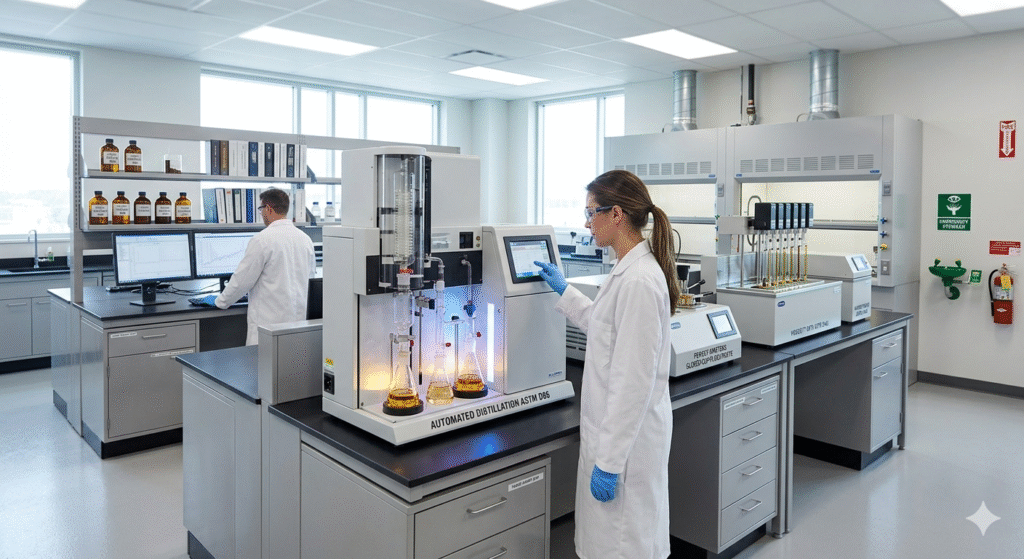
Many engineers make the mistake of overlooking infrastructure. A petroleum testing laboratory setup requires specialized ventilation (fume hoods for volatile organic compounds), explosion-proof electrical fittings, and precise climate control.
Failure to adhere to WHO Laboratory Safety Guidelines regarding chemical storage and waste management can result in costly legal setbacks and safety hazards. Ensure your lab furniture is chemical-resistant and that gas lines for your GC are properly manifolded.
[Image Suggestion]
Visual: A wide-angle shot of a modern petroleum laboratory with organized workstations, technicians using automated distillation units, and clear safety signage.
ALT Text: Professional petroleum testing laboratory setup featuring high-end analysis equipment and safety-compliant infrastructure.
5. Why Partner with a Guangzhou Laboratory Equipment Supplier?
When it comes to balancing cost and quality, sourcing from a China-based laboratory equipment supplier offers distinct competitive advantages. Specifically, the Guangzhou industrial hub is world-renowned for its sophisticated manufacturing and logistics infrastructure.
The Labvv Advantage: Your Solution Provider
As a premier laboratory equipment manufacturer and solution provider based in Guangzhou, China, we offer more than just hardware. We provide a bridge between factory-level pricing and international quality standards.
- Cost-Effective Solutions: We provide factory price access by eliminating middleman layers, ensuring your budget goes further without compromising on precision.
- One-Stop Sourcing: Our multi-brand sourcing capability means you can procure your XRF analyzers, centrifuge tubes, and reference materials from a single, reliable point of contact.
- OEM/ODM Support: We customize equipment configurations—from voltage requirements to specialized sensors—to fit your specific workflow.
- Global Shipping & Fast Delivery: Utilizing Guangzhou’s world-class port facilities, we ensure your petroleum testing laboratory setup reaches your site safely and on schedule.
Internal Resources for Lab Managers:
- How to maintain Kinematic Viscometers for 10+ years
- Top 10 Essential Lab Consumables for Oil Analysis
Frequently Asked Questions (FAQ)
Q: How long does a full petroleum testing laboratory setup take?
A: Depending on the scope, a standard fuel testing lab takes 4–8 weeks for equipment production and 2–4 weeks for global shipping.
Q: Do you provide installation and training?
A: Yes, we provide comprehensive video installation guides, remote technical sessions, and on-site training for large-scale procurement projects.
Q: Is your equipment compliant with ASTM standards?
A: Absolutely. Every piece of equipment is calibrated to meet or exceed specific ASTM and ISO standards, with certificates provided upon delivery.
Conclusion: Start Your Lab Build Today
A successful petroleum testing laboratory setup is a marathon, not a sprint. By focusing on compliant equipment, safety standards, and a reliable supply chain partner, you can ensure your facility delivers accurate results for years to come.
Ready to optimize your procurement process?
Stop dealing with multiple vendors and inconsistent quality. Contact us today to receive a comprehensive technical proposal and factory price quote for your project.
Contact our technical team in Guangzhou via email or WhatsApp to discuss your specific testing needs.
Have questions or need expert guidance?
Reach out to our Labvv team !