Sourcing a high-performance pour point tester is a critical decision for laboratory managers and procurement specialists worldwide. In the petroleum and lubricant industries, the precision of cold-flow testing directly impacts product safety and regulatory compliance. However, many buyers struggle with inconsistent equipment quality, lack of technical support, and opaque pricing from middlemen.
Whether you are looking for a manual setup or a fully automated system, this guide provides the technical insights and procurement strategies needed to select a laboratory equipment supplier that delivers both precision and value.
1. What is a Pour Point Tester?
A pour point tester measures the lowest temperature at which a liquid specimen (oil, fuel, or lubricant) maintains its ability to flow. Parallel to this is the Cloud Point, the temperature where wax crystals first appear.
For industrial applications, compliance with international standards is non-negotiable. Most global contracts require testing according to:
- ASTM D97: Standard Test Method for Pour Point of Petroleum Products.
- ASTM D2500 / ISO 3015: Standard Test Method for Cloud Point.
- ISO 3016: Petroleum products — Determination of pour point.
Pro Tip: If your lab handles high volumes, transitioning from manual to an automatic pour point tester can reduce labor costs by up to 60% and eliminate operator bias.
2. Comparison: Manual vs. Automatic Pour Point Testers
To help you decide which model fits your budget and throughput, refer to the table below:
| Feature | Manual Pour Point Tester | Automatic Pour Point Tester |
| Precision | Dependent on operator skill | High (Microprocessor controlled) |
| Cooling Method | Dry ice or external bath | Integrated compressor (up to -70°C) |
| Throughput | Low (Single sample) | High (Multi-slot testing) |
| Data Logging | Manual entry | USB/LIMS integration |
| Best For | Small labs / Low frequency | Commercial labs / Refineries |
[👉 Need a detailed quote? Get expert recommendations within 24 hours]
3. Buying Guide: Key Specifications to Evaluate
When vetting a laboratory equipment manufacturer, don’t just look at the factory price. Focus on these technical pillars:
A. Temperature Range and Control
Ensure the cooling bath can reach at least 15°C below your lowest expected pour point. Premium models offer stability within ±0.1°C, ensuring repeatability that meets ISO requirements.
B. Cooling System Efficiency
Look for CFC-free, multi-stage compressor cooling. This eliminates the need for external cooling water or hazardous dry ice, making your lab safer and more eco-friendly.
C. Safety Features
High-quality testers should include over-temperature protection, high-pressure protection for the compressor, and automated sensors to detect sample movement.
4. Supplier Selection: Why the “Guangzhou Advantage” Matters
Choosing a China-based laboratory equipment supplier is a strategic move for cost-effectiveness, but not all suppliers are equal. Partnering with a specialist in Guangzhou offers unique advantages:
- Supply Chain Integration: As a leading Guangzhou laboratory equipment supplier, we integrate the entire production chain. We aren’t just selling a box; we provide a complete testing solution.
- OEM & ODM Support: We offer robust OEM laboratory equipment services for global distributors, including custom branding, software localization, and hardware modifications.
- Cost-Effective Factory Pricing: By eliminating multiple layers of distributors, we provide factory prices that allow you to stay within budget without sacrificing accuracy.
- Global Logistics: With proximity to major shipping hubs, we guarantee fast delivery and stable quality control for every shipment.
5. Major Application Scenarios
- Oil & Gas Refineries: Testing diesel, jet fuel, and crude oil flowability.
- Lubricant Production: Quality control for engine oils and hydraulic fluids.
- Environmental Research: Studying the behavior of biofuels in Arctic conditions.
- Power Plants: Testing transformer oils to prevent cold-start failures.
6. Frequently Asked Questions (FAQ)
Why is ASTM D97 compliance important?
ASTM D97 is the global benchmark. Using a pour point tester that adheres to this standard ensures your test results are legally and commercially valid in international markets.
What is the lead time for a custom OEM order?
Typically, our standard models ship within 7-14 business days. For OEM laboratory equipment with custom branding, lead times range from 4 to 6 weeks depending on specifications.
Do you provide calibration certificates?
Yes. Every unit is calibrated against traceable standards before leaving our factory, ensuring it is ready for immediate use in your facility.
7. Strategic Call-to-Action (CTA)
Stop overpaying for lab equipment through multiple middlemen. Partner with a professional laboratory equipment manufacturer who understands the technical demands of your industry.
- [Request a Quote Today] – Get a competitive price list for our 2026 models.
- [Contact Us for Specifications] – Discuss your specific ASTM or ISO requirements with our engineers.
- [Send Your Requirements Now] – Receive a customized laboratory solution within 24 hours.
Image Suggestion:
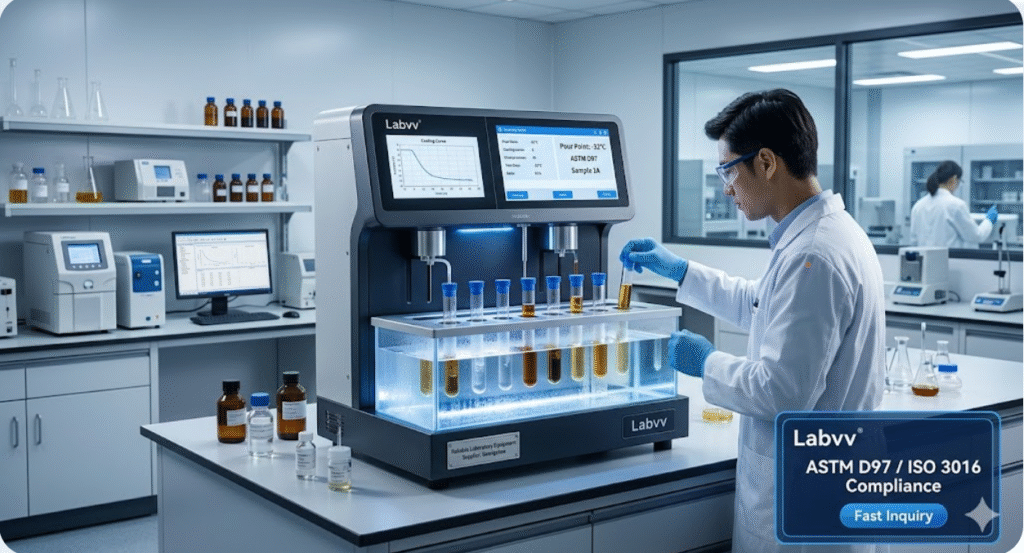
Insert a high-resolution photo of an Automatic Pour Point Tester showing the digital interface and the cooling bath.
ALT Text: Automatic pour point tester for ASTM D97 petroleum testing – Factory Price
Internal Links:
External Links: